
The World Health Organization (WHO) and the Government of the Republic of Korea convened in Seoul for their second high-level Strategic Dialogue, marking a significant milestone in a collaborative relationship that has endured for more than seven decades. The two-day gathering, held from August 28 to 29, 2024, brought together senior health diplomats, policymakers, and technical experts to align priorities, review ongoing joint initiatives, and forge a robust path forward for global health security and development.
This latest dialogue underscores a remarkable transformation in the Republic of Korea’s international status. Once a recipient of international aid and humanitarian assistance in the aftermath of the Korean War, the nation has evolved into a formidable donor country and an indispensable leader in global health governance. Today, Seoul plays a critical, catalytic role on the world stage, championing health equity, biomanufacturing capacity, and multilateral cooperation to address persistent and emerging health emergencies.
A Chronology of Partnership: From Post-War Recovery to Global Leadership
To fully understand the weight of the August 2024 Strategic Dialogue, one must examine the historical trajectory of cooperation between the WHO and the Republic of Korea. The partnership commenced shortly after the establishment of the Republic of Korea in 1948 and the nation’s subsequent admission to the World Health Organization. In its earliest decades, the collaboration was primarily focused on rebuilding a devastated healthcare infrastructure, eradicating infectious diseases such as tuberculosis, malaria, and smallpox, and establishing basic sanitation and maternal-child health services.
By the late 20th century, as the Republic of Korea’s economy experienced rapid industrialization—often referred to as the "Miracle on the Han River"—the nature of the partnership began to shift. The country transitioned from being a consumer of international aid to a contributor. Throughout the 1990s and 2000s, Seoul increased its voluntary contributions to the WHO and bilateral health initiatives, sharing its own developmental expertise with low- and middle-income countries.
In recent years, this leadership manifested profoundly during global health crises. The Republic of Korea’s response to outbreaks such as Middle East Respiratory Syndrome (MERS) in 2015 and its globally acclaimed, science-driven containment of COVID-19 without sweeping lockdowns positioned the nation as a vanguard of public health innovation. Furthermore, Seoul’s designation by the WHO as a global biomanufacturing training hub in 2022 cemented its status as a pillar of vaccine equity, particularly for low- and middle-income nations seeking to build domestic manufacturing capabilities.
High-Level Delegations and Strategic Objectives
The second Strategic Dialogue in Seoul served as a comprehensive platform to review this expansive portfolio of cooperation. The WHO delegation was led by Dr. Catharina Boehme, Assistant Director-General for External Relations and Governance. Dr. Boehme’s delegation included an in-person team of technical and financial experts alongside colleagues participating virtually from all three levels of the WHO—headquarters in Geneva, regional offices, and country-level operations.
Representing the host nation, the high-powered Korean delegation was led by Dr. Hye-Jin Kim, Deputy Minister for Planning and Coordination at the Ministry of Health and Welfare. The discussions also drew upon the deep expertise of other vital government bodies, reflecting the multisectoral nature of modern global health security. Notably, Dr. Young-Mee Jee, Commissioner of the Korea Disease Control and Prevention Agency (KDCA), participated alongside senior counterparts from the Ministry of Foreign Affairs and the Ministry of Food and Drug Safety.

In alignment with the WHO’s ongoing strategic initiatives to foster parliamentary engagement and legislative support for global health, the WHO delegation expanded its diplomatic footprint in Seoul. Members of the international delegation held targeted consultations with various parliamentarians from the National Assembly who have consistently championed international health agendas, universal health coverage, and health security funding.
Aligning Priorities and Strengthening Financial Frameworks
The core agenda of the two-day summit centered on harmonizing strategic priorities between the WHO’s Fourteenth General Programme of Work (GPW 14) and the Republic of Korea’s official development assistance (ODA) strategies. Discussions probed deeply into multilateral financing, health system resilience, pandemic prevention, preparedness, and response (PPPR), and the acceleration of progress toward the Sustainable Development Goals (SDGs).
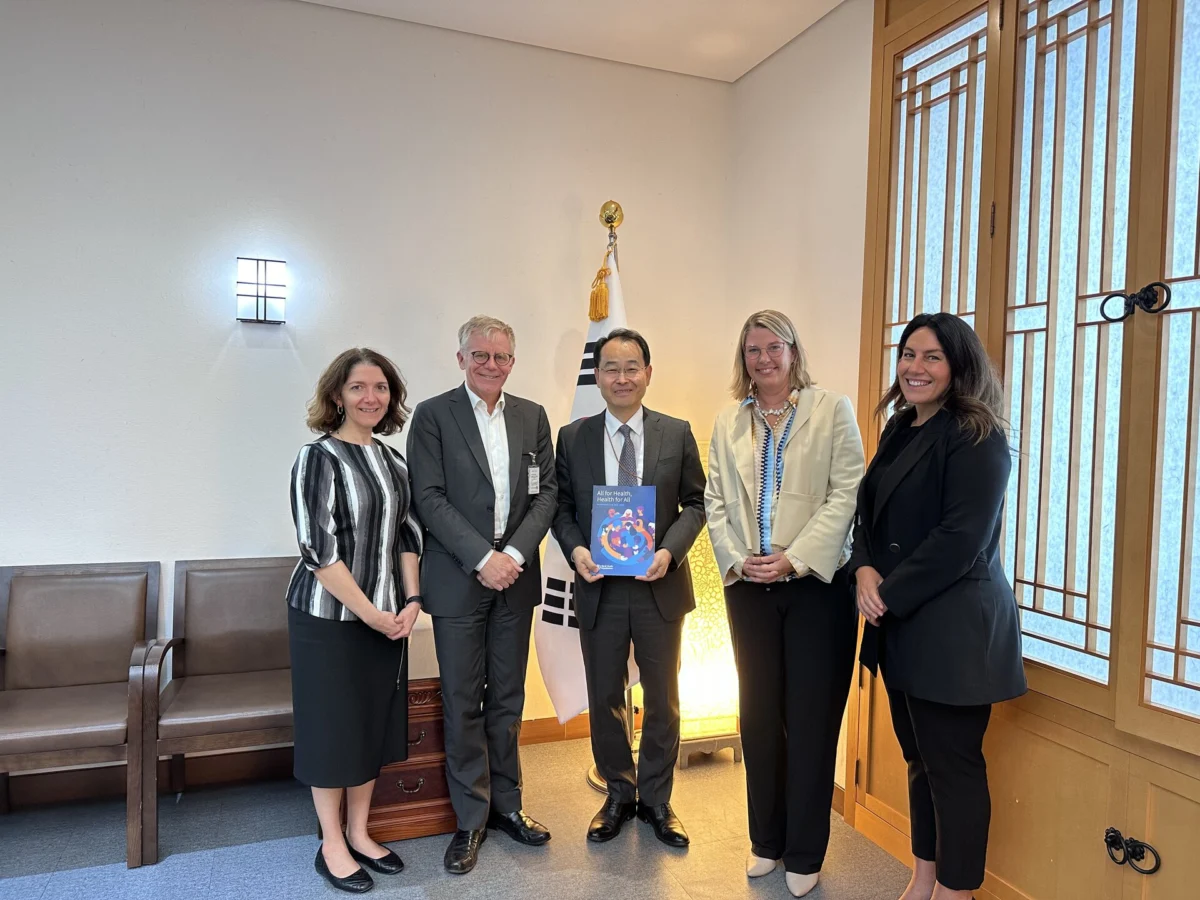
A central focal point during the meetings was the promotion of sustainable, predictable financing for the WHO. The delegations engaged in substantive reviews of the WHO Investment Case report, a comprehensive blueprint outlining the return on investment for global health funding. During a symbolic and collaborative moment captured during the event, members of the WHO delegation stood alongside Mr. Jonghan Park, Director-General for Development Cooperation at the Ministry of Foreign Affairs, holding up the WHO Investment Case report to signal shared dedication to robust resource mobilization.
The alignment of priorities achieved during the August meetings ensures that Korean development assistance will continue to target high-impact areas, including:
- Strengthening health systems in vulnerable regions, particularly across the Asia-Pacific and African continents.
- Advancing digital health innovations and artificial intelligence applications in medicine.
- Enhancing global regulatory harmonization through the expertise of the Ministry of Food and Drug Safety.
- Supporting the WHO Academy to train millions of health workers worldwide through cutting-edge educational methodologies.
Official Perspectives and Institutional Reactions
While the Strategic Dialogue was conducted behind closed doors to encourage candid diplomatic and technical exchange, official statements released following the conclusion of the talks highlighted a shared vision for multilateralism.
Spokespersons from the Ministry of Health and Welfare emphasized that the Republic of Korea views its investment in global health not merely as a matter of foreign aid, but as a direct contribution to national and international security. By helping other nations build resilient health systems, Seoul safeguards its own population from cross-border health threats, antimicrobial resistance, and emerging pathogens.
Similarly, WHO representatives lauded the Republic of Korea’s whole-of-government approach. The active participation of the KDCA, the Ministry of Foreign Affairs, and the Ministry of Food and Drug Safety demonstrated that Seoul understands health security requires synchronized efforts spanning diplomacy, rigorous disease surveillance, regulatory excellence, and clinical preparedness. The WHO underscored that Korea’s willingness to share lessons learned from its domestic health reforms serves as a valuable blueprint for other transitioning economies.
Broader Implications for Global Health Architecture
The outcomes of the second WHO-Republic of Korea Strategic Dialogue arrive at a critical juncture for international health governance. As the global community continues to process the lessons of the COVID-19 pandemic, multilateral institutions face mounting pressure to demonstrate agility, transparency, and financial sustainability.

The strengthening partnership between the WHO and Seoul carries several key implications for the broader geopolitical and public health landscape:
-
Catalyzing Vaccine and Therapeutic Equity: Through its ongoing support for the WHO global biomanufacturing training hub and related technology transfer initiatives, the Republic of Korea is helping bridge the historic equity gaps that left developing nations vulnerable during previous health emergencies. The Seoul dialogue reinforced commitments to ensure that manufacturing capacity is geographically diversified.
-
Advancing Global Health Security Architecture: As negotiations surrounding international health agreements and amendments to the International Health Regulations (IHR) unfold, the alignment between a major donor like South Korea and the WHO provides a stabilizing anchor. Korea’s technical prowess in contact tracing, diagnostic manufacturing, and data analytics enriches global technical guidelines.
-
Setting a Benchmark for Donor-Recipient Evolution: The journey of the Republic of Korea offers a compelling empirical model for international development. It demonstrates how targeted international assistance, coupled with domestic political will, educational investment, and economic reform, can transform a nation into a net provider of global public goods. The WHO frequently highlights this trajectory when encouraging emerging economies to invest in international health cooperation.
Looking Ahead
As the delegations concluded their meetings in Seoul, the focus immediately shifted toward operationalizing the agreements reached during the two-day summit. Follow-up mechanisms have been established to monitor the implementation of joint projects, track financial commitments, and ensure continuous dialogue between technical experts in Geneva, regional hubs, and Seoul.
The 75-year partnership between the World Health Organization and the Republic of Korea, reaffirmed and modernized through the second Strategic Dialogue, stands as a testament to what can be achieved through sustained international solidarity. By combining the WHO’s global normative authority with Korea’s financial, technical, and diplomatic dynamism, the partnership is uniquely equipped to confront the complex health challenges of the 21st century, ensuring a safer, healthier future for populations worldwide.






Leave a Reply