The ancient Maya civilization, renowned for its architectural marvels, sophisticated writing system, and profound mathematical and astronomical achievements, left behind a legacy that continues to captivate modern researchers. However, a startling new scientific investigation has revealed a dark, microscopic downside to the civilization’s vibrant aesthetic culture. According to recent geochemical analyses of sediment cores extracted from ancient Maya reservoirs and lake beds, the relentless pursuit of artistic expression and ritualistic splendor led the population to inadvertently poison their own municipal water sources with high levels of toxic mercury.
The primary culprit behind this environmental contamination was cinnabar, a striking, vivid-red mercury-sulfide mineral heavily favored by the Maya as a pigment for murals, pottery, funerary decorations, and body paint. While contemporary society is acutely aware of the severe health hazards posed by heavy metals, the ancient builders had no inkling that their artistic traditions were gradually turning their essential water supplies into toxic repositories. This unintended self-contamination adds a complex new dimension to ongoing academic discussions regarding environmental degradation, public health crises, and the ultimate societal transformations that characterized the decline of major Classic Maya centers.
The Chemical Mechanism of Ancient Contamination
To understand how a mineral pigment could transform a pristine freshwater reservoir into a toxic hazard, scientists must examine the complex biogeochemical pathways that occur in aquatic environments. Cinnabar, chemically known as mercury sulfide ($textHgS$), is relatively stable in its raw, solid state. However, when large quantities of the mineral are washed via rainwater runoff from urban structures, plazas, and painted artifacts into low-oxygen lake beds and enclosed reservoirs, a dangerous transformation takes place.
Within the anaerobic sediments at the bottom of these aquatic systems—environments largely devoid of oxygen—specialized anaerobic bacteria interact with the mineral deposits. Through microbial processes, these microorganisms methylate the inorganic mercury, converting it into methylmercury ($mathrmCH_3Hg^+$). Methylmercury is an exceptionally potent neurotoxin that is easily absorbed by aquatic organisms, including algae, benthic invertebrates, and fish.
Crucially, unlike many other toxins, methylmercury does not easily break down or excrete from biological systems. Instead, it undergoes biomagnification, a process whereby the concentration of the toxin multiplies exponentially as it moves upward through the food chain. Small organisms consume the contaminated sediment, larger fish consume many contaminated smaller organisms, and apex predators—and humans—absorb the cumulative toxic load at the top of the food chain. Consequently, the Maya living in dense urban centers were likely consuming mercury-laced water and aquatic life on a regular basis, compounding the toxic burden within their bodies over decades of habitation.
Chronology of Pigment Production and Urban Growth
The reliance of the Maya on red pigments spans millennia, evolving from modest early practices into an industrial-scale consumption pattern during the Classic period. Archaeological evidence suggests that the use of red ochre and cinnabar began as early as the Middle Preformative period, around 1000 BCE. Initially, these minerals were reserved for elite burials, significant architectural facades, and sacred ritual items.
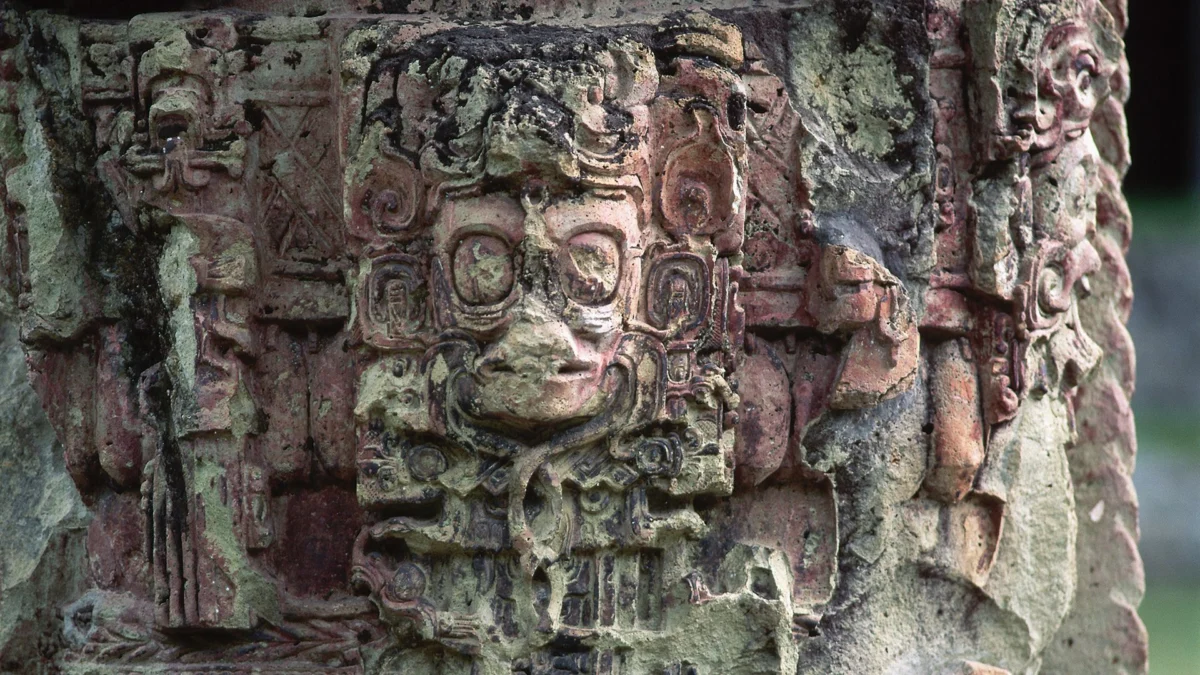
As urban centers expanded between 250 CE and 900 CE—a timeframe recognized as the Classic Maya period—the demand for cinnabar surged dramatically. Major metropolitan areas such as Tikal, Palenque, Calakmul, and Copán transformed into bustling urban landscapes where public plazas, royal palaces, stelae, and stucco-covered pyramids were coated in brilliant layers of red paint.
- Preclassic Period (1000 BCE – 250 CE): Initial adoption of cinnabar for elite mortuary contexts and limited ritual use. Environmental impact remains localized and negligible.
- Early to Late Classic Period (250 CE – 850 CE): Rapid urbanization and population growth lead to intensive mining, processing, and application of cinnabar on a massive architectural scale. Runoff accumulates in artificial reservoirs and natural lakes.
- Terminal Classic and Postclassic Periods (850 CE – 1500 CE): High baseline concentrations of mercury settle into the sediment record, coinciding with sociopolitical stress, drought, and the eventual abandonment of major lowland urban centers.
During the peak of the Classic period, the sheer volume of paint applied to buildings meant that every heavy tropical downpour washed microscopic particles of cinnabar off exposed surfaces and directly into the interconnected drainage networks and catchment basins that sustained the urban populations.
Supporting Geochemical Data
The discovery of this heavy metal pollution emerged from meticulous multi-disciplinary research led by geoarchaeologists and environmental scientists studying sediment cores from ancient Maya lakes, including Lake Yaxhá and Lake Petén Itzá in Guatemala, as well as enclosed reservoirs within specific archaeological ruins.
When researchers analyzed cross-sections of sediment layers corresponding to the height of Classic Maya occupation, they discovered mercury concentrations that were several times higher than natural geological background levels. In some specific reservoir sediments, mercury levels exceeded safety thresholds by orders of magnitude. Crucially, the spike in mercury levels directly correlated chronologically with indicators of intense human activity, such as elevated concentrations of phosphorus, charcoal (reflecting land clearance and cooking fires), and architectural stucco fragments.
Furthermore, skeletal remains recovered from ancient Maya burial sites within these regions have frequently shown elevated levels of mercury in bone and hair samples. While some of this mercury accumulation was undoubtedly the result of direct occupational exposure—such as artisans inhaling toxic dust while grinding cinnabar rocks into fine pigment—the broad distribution of elevated heavy metal levels across general populations strongly points toward systemic environmental contamination via drinking water and diet.
Official Assessments and Scientific Consensus
Archaeologists and environmental toxicologists analyzing these findings emphasize that while the mercury poisoning was entirely accidental, its societal implications are profound. Dr. Susan Richardson, an environmental chemist specializing in water quality and contaminant analysis, notes that ancient populations frequently struggled with the unintended consequences of their own resource management.
"When we look at ancient civilizations, our primary focus is often on warfare, climate change, or agricultural collapse," remarks Richardson. "However, micro-environmental degradation, such as heavy metal accumulation in closed hydrological systems, represents an insidious internal threat that can silently undermine public health, cognitive function, and social stability over generations."
Other researchers point out that the Maya were exceptionally skilled water engineers, constructing vast networks of canals, limestone filtration beds, and artificial reservoirs to survive the seasonal droughts characteristic of the Mesoamerican lowlands. Ironically, the very engineering triumphs that allowed them to concentrate large populations in water-scarce regions also created closed hydrological traps where heavy metals like mercury could accumulate without a natural flushing mechanism.
Broader Impact and Implications for Modern Societies
The realization that ancient urban centers suffered from chronic heavy metal contamination offers vital lessons that extend far beyond Mesoamerican archaeology. It serves as a stark reminder of the complex, often unpredictable feedback loops between human technological choices and natural ecosystems.
As modern industrial societies grapple with contemporary challenges involving chemical pollutants, microplastics, and heavy metal runoff, the Maya case study highlights the vulnerability of municipal water systems to persistent toxins. The accumulation of mercury in aquatic sediment is a slow, cumulative process that leaves few visible warning signs until the ecological and health impacts have reached critical thresholds.
Moreover, historians and anthropologists are increasingly factoring environmental health crises into holistic models of societal resilience and collapse. While the decline of the Classic Maya civilization was undoubtedly driven by a combination of severe, prolonged droughts, political fragmentation, and agricultural overextension, chronic heavy metal toxicity may have served as an under-recognized contributing factor. A populace suffering from the neurological, cognitive, and physical ailments associated with long-term mercury exposure—such as tremors, impaired motor skills, developmental disorders, and psychological distress—would have been significantly less resilient in the face of systemic environmental and political shocks.
As ongoing scientific excavations continue to analyze sediment records across the ancient Maya world, researchers hope to map the precise geographical extent of the contamination. These investigations not only deepen our understanding of the daily realities of life in one of history’s most fascinating civilizations but also underscore the timeless imperative of safeguarding our shared natural resources from unintended chemical hazards.