
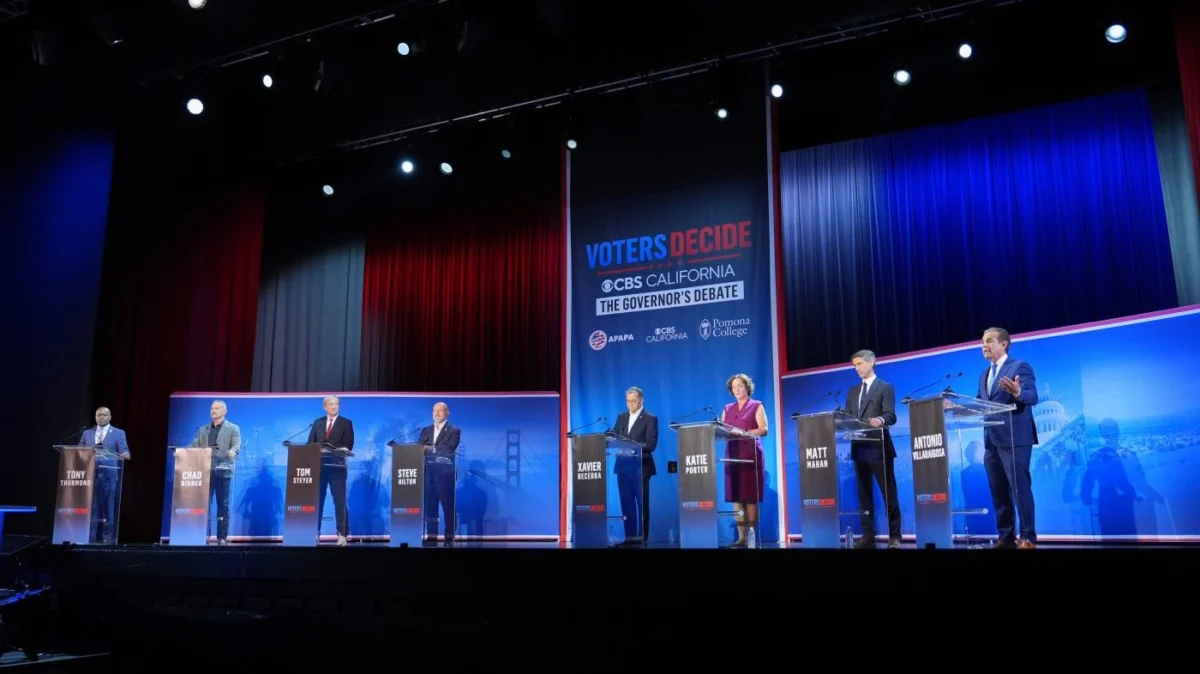
The race for California’s governorship plunged into further disarray Tuesday night as a crowded field of candidates struggled to distinguish themselves in a raucous debate at Pomona College, marking a pivotal moment in the Democratic Party’s urgent quest to coalesce behind a frontrunner following the dramatic exit of former Rep. Eric Swalwell. The 90-minute forum, hosted by CBS News, devolved into a cacophony of crosstalk, interruptions, and direct challenges to moderators, reflecting the high stakes and palpable tension among contenders vying for leadership in the nation’s most populous state.
A Scrambled Field and the Shadow of Swalwell’s Exit
The debate unfolded against the backdrop of a significantly reshaped political landscape in California. Just weeks prior, former Representative Eric Swalwell (D-Calif.), widely regarded as a formidable Democratic frontrunner, withdrew from the gubernatorial contest amid a cloud of sexual misconduct allegations. His abrupt departure created a vacuum, leaving a fragmented Democratic field scrambling for his endorsements, his voter base, and the mantle of party leadership. This sudden realignment injected a new level of urgency into a race already characterized by its unique "top-two" primary system, which allows the two highest vote-getters, regardless of party affiliation, to advance to the general election.
The deep blue stronghold of California, a state that consistently votes Democratic in presidential elections and holds immense sway in national politics, faces the unusual prospect of a potential Republican-on-Republican general election if Democrats fail to unify behind strong candidates. While political analysts widely consider such an outcome a longshot, the possibility looms large enough to fuel anxiety within the state party, prompting calls for less viable candidates to step aside. California, with its immense economy, often ranked among the largest in the world, and its diverse population of nearly 40 million, represents a critical ideological battleground. The governor’s office wields significant power over policy on climate change, housing, healthcare, education, and technology, making the race a bellwether for progressive governance and a focal point for national political observers.
The Dynamics of the Debate: A Chaotic Showdown
Eight gubernatorial hopefuls, ranging from established political figures to a billionaire entrepreneur and a Trump-backed Republican, crowded the stage at Pomona College in Claremont, California. The lineup included California Attorney General Xavier Becerra, billionaire environmentalist Tom Steyer, former Representative Katie Porter (D-Calif.), Republican firebrand Steve Hilton, Riverside County Sheriff Chad Bianco (R), San Jose Mayor Matt Mahan, State Superintendent Tony Thurmond, and former Los Angeles Mayor Antonio Villaraigosa.
From the outset, the debate was marked by its combative nature, diverging sharply from a more subdued encounter just a week prior. Candidates frequently interrupted one another, engaged in pointed crosstalk, and openly sparred with the moderators, CBS News’s Julie Watts and CBS Los Angeles’s Pat Harvey, over allocated speaking time and factual assertions. "Wow, that was a bit of a mess," remarked Pomona College student Ryan Kossarian, encapsulating the sentiment of many observers as he stepped up to ask a question. Representative Porter succinctly summarized the disarray, quipping that the back-and-forth was "worse than my teenagers at dinner," a sentiment that resonated with viewers witnessing the often-unruly exchanges. The chaotic environment, while perhaps generating viral moments, raised questions among political strategists about whether any candidate truly managed to "break through" and connect with voters on substantive policy.
Critical Issues Facing the Golden State
The debate centered on pressing issues confronting California residents, including the escalating housing crisis, pervasive affordability concerns, and broader economic challenges. These issues, exacerbated by a high cost of living, have become central to the gubernatorial campaigns, with each candidate attempting to present distinct solutions.
California’s housing crisis, for instance, is not merely an abstract policy challenge but a daily struggle for millions. The median home price in California consistently ranks among the highest in the nation, often exceeding twice the national average. In March 2026, the median home price in the state hovered around $840,000, significantly higher than the national median of approximately $420,000. This disparity has led to widespread homelessness, long commutes, and an exodus of residents seeking more affordable living conditions in other states. Candidates grappled with proposing viable strategies, from streamlining zoning regulations and increasing housing supply to rent control and state subsidies. The affordability crisis extends beyond housing, impacting everything from gasoline prices—which are consistently among the highest in the nation due to taxes and environmental regulations—to utility costs, placing significant financial strain on working families and the middle class. Healthcare access and costs, climate change resilience, and wildfire prevention also featured prominently in the discussion, reflecting the multi-faceted challenges facing the Golden State.
Key Rivalries and Notable Exchanges
The most intense exchanges of the night often occurred between the perceived Democratic frontrunners, Xavier Becerra and Tom Steyer, and between Democrats and the leading Republican, Steve Hilton.
The Becerra-Steyer Feud: Attorney General Xavier Becerra, who saw a significant surge in polls and endorsements following Swalwell’s exit, found himself frequently targeted by billionaire Tom Steyer. Steyer, a self-funded candidate with deep pockets gained from his career in finance, criticized Becerra as a "career politician" and attacked him for allegedly accepting funds from Chevron, a move designed to undermine Becerra’s environmental credentials and appeal to progressive voters. Becerra, a long-time public servant who has served in both Congress and as Attorney General, in turn, countered by leveraging Steyer’s immense personal wealth, famously stating, "we will not let billionaires buy their way into office." This ideological clash between a seasoned public servant and a wealthy outsider underscores a broader tension within the Democratic Party regarding the role of money in politics and the path to progressive governance.
Porter’s Progressive Challenge: Former Rep. Katie Porter distinguished herself with her characteristic directness and sharp questioning. She challenged Steyer directly when he spoke about oil companies causing environmental damage, interjecting, "So they were causing great damage while you were investing in them?" This pointed query highlighted her reputation as a formidable interrogator, often armed with whiteboards in congressional hearings, and positioned her as a progressive voice willing to hold powerful figures accountable. Her interventions often cut through the noise, attempting to distill the essence of the arguments and, at times, the chaos. Porter’s ability to articulate progressive stances while also highlighting perceived inconsistencies in her opponents’ records has made her a compelling figure in the race, particularly among younger and more ideologically driven voters.
Clashes with Moderators: The candidates’ eagerness for airtime led to several testy exchanges with the moderators. CBS News’s Julie Watts notably clashed with Steyer over a question concerning oil refining, going so far as to direct the audience to her outlet’s website to verify Steyer’s past statements. When Steyer protested Watts moving on to Porter, she reportedly threatened to "cut the mic if you don’t — if you’re not respectful." Similarly, Becerra, displaying a more animated demeanor than in previous debates, challenged Watts on his plan for a proposed state of emergency to freeze insurance rates, declaring he’d "be willing to go to court" with her. San Jose Mayor Matt Mahan also sought out opportunities for the spotlight, jumping in when some of his rivals complained about their allotted time. These interactions underscored the candidates’ desperation to control the narrative and maximize their limited opportunities to connect with voters, often at the expense of a coherent, policy-focused discussion.
Inter-Party Jabs: The cross-aisle attacks were equally sharp. Steve Hilton, a former Fox News host and a prominent voice on the right, launched a direct jab at Becerra, stating, "We can’t have a governor who doesn’t understand how the government works." Becerra swiftly retorted, "And we don’t need a talking head from Fox News to tell us how the government works," highlighting the deep partisan divide. Becerra further targeted Hilton by invoking former President Trump, stating that to ease healthcare affordability woes, "the first thing we have to do is stop Steve Hilton’s daddy, who has endorsed him," a clear reference to Trump’s backing of the leading GOP candidate. Riverside County Sheriff Chad Bianco, another Republican, consistently criticized California’s Democratic leadership and the Democratic contenders on stage, emphasizing his outsider appeal and frustration with the state’s direction. Bianco notably complained of a lack of airtime, remarking, "I wasn’t sure I was even up here any more," after a moderator moved on from him. State Superintendent Tony Thurmond and former Los Angeles Mayor Antonio Villaraigosa, both struggling to gain traction, also participated, under scrutiny as Democrats fret about candidate viability in the crowded field. As CBS Los Angeles’s Pat Harvey aptly observed at one point, "You know what’s interesting? Everybody wants to talk at this debate."
The Polling Landscape and Democratic Anxieties
Recent polling data paints a complex and fluid picture of the race, contributing to the Democratic Party’s apprehension. A CBS News/YouGov poll released just ahead of the debate showed Republican Steve Hilton leading with 16 percent support, closely followed by Democrat Tom Steyer at 15 percent. Becerra and Bianco were the only other candidates to register double-digit support, underscoring the fragmented nature of the field. This poll, conducted among likely voters, had a margin of error of +/- 3.5 percentage points, suggesting a tight race at the top.
Earlier data from Emerson College Polling/Inside California Politics revealed Becerra’s significant ascent. Before Swalwell’s departure, Becerra had been stuck in single digits, but he surged by 7 points following the former congressman’s withdrawal, indicating a direct transfer of support or increased visibility as voters sought a new mainstream Democratic option. However, even with this momentum, the latest California Democratic Party internal polling, shared last week, showed Steyer and Becerra tied at 13 percent each, critically trailing the two top Republican candidates in a hypothetical scenario. These numbers highlight the challenge Democrats face in consolidating their base, which is often ideologically diverse, encompassing progressive, moderate, and establishment wings.
This polling dynamic is particularly troubling for Democrats given California’s "top-two" primary system. In this system, implemented by Proposition 14 in 2010, all candidates run on a single ballot, and the two candidates receiving the most votes, regardless of party, advance to the general election. While California is overwhelmingly Democratic (with registered Democrats outnumbering Republicans by nearly two to one – approximately 47% Democrat to 24% Republican, as of recent voter registration data), a highly fragmented Democratic field could theoretically split the vote sufficiently to allow two Republicans to emerge from the primary. This scenario, though statistically improbable in a gubernatorial race given the party’s registration advantage and the sheer volume of Democratic voters, remains a lingering fear, especially after similar outcomes in past statewide contests, such as the 2018 U.S. Senate primary where two Democrats, Dianne Feinstein and Kevin de León, advanced to the general election, effectively shutting out Republican representation in the general election for a major statewide office.
The urgency of the situation prompted California Democratic Party Chair Rusty Hicks to issue a stark warning last week, publicly stating that candidates "struggling in the single digits should give serious consideration to stepping back." This unusual intervention underscored the party’s growing concern over the lack of a clear Democratic standard-bearer and the potential for a disastrous primary outcome, which could divert critical resources and attention away from other key races.
Ahead of the Vote: What’s Next
The stakes for the candidates, particularly Becerra and Steyer and other Democrats within striking distance of frontrunner status, were exceptionally high at the Pomona debate. With ballots set to be mailed to voters next week, starting on May 4th, the opportunity to make a decisive impression is rapidly diminishing. The debate was a crucial, if chaotic, platform for candidates to make their case to a statewide audience, especially those undecided voters who tend to tune in closer to election day.
Despite any candidates potentially heeding Chair Hicks’s advice to withdraw, their names – like Swalwell’s – will still appear on the primary ballot, further complicating voter choices and potentially diluting the vote for viable candidates. The primary election, scheduled for June 2, will serve as the true test of who has managed to break through the crowded field and secure a spot in the general election. Political analysts suggest that a significant turnout, especially among engaged Democratic voters, will be crucial to prevent the feared two-Republican runoff scenario, which would be an unprecedented embarrassment for the state party.
Beyond the gubernatorial race, Californians will also be casting their votes in critical House contests across the state. The recently approved Proposition 50, which established a new electoral map based on the latest census data, has created several new pickup opportunities for Democrats, making California a crucial battleground in the national struggle for control of Congress. The outcomes of these races will not only shape the state’s political future but also have significant ramifications for the balance of power in Washington, impacting the legislative agenda and the ability of either party to enact its priorities at the federal level.
The candidates are set to meet again next Tuesday in another high-profile debate, this time hosted by CNN. With the primary election rapidly approaching and the field still unsettled, the pressure to deliver a clear, compelling message and differentiate themselves from the pack will only intensify. The coming weeks will determine whether California Democrats can successfully navigate their tumultuous primary and present a unified front to maintain their hold on the Golden State’s highest office. The implications for the state’s future policies on critical issues like climate change, economic inequality, and social justice, as well as its role in national politics, hinge on the outcome of this fiercely contested and often unpredictable election cycle.









Leave a Reply