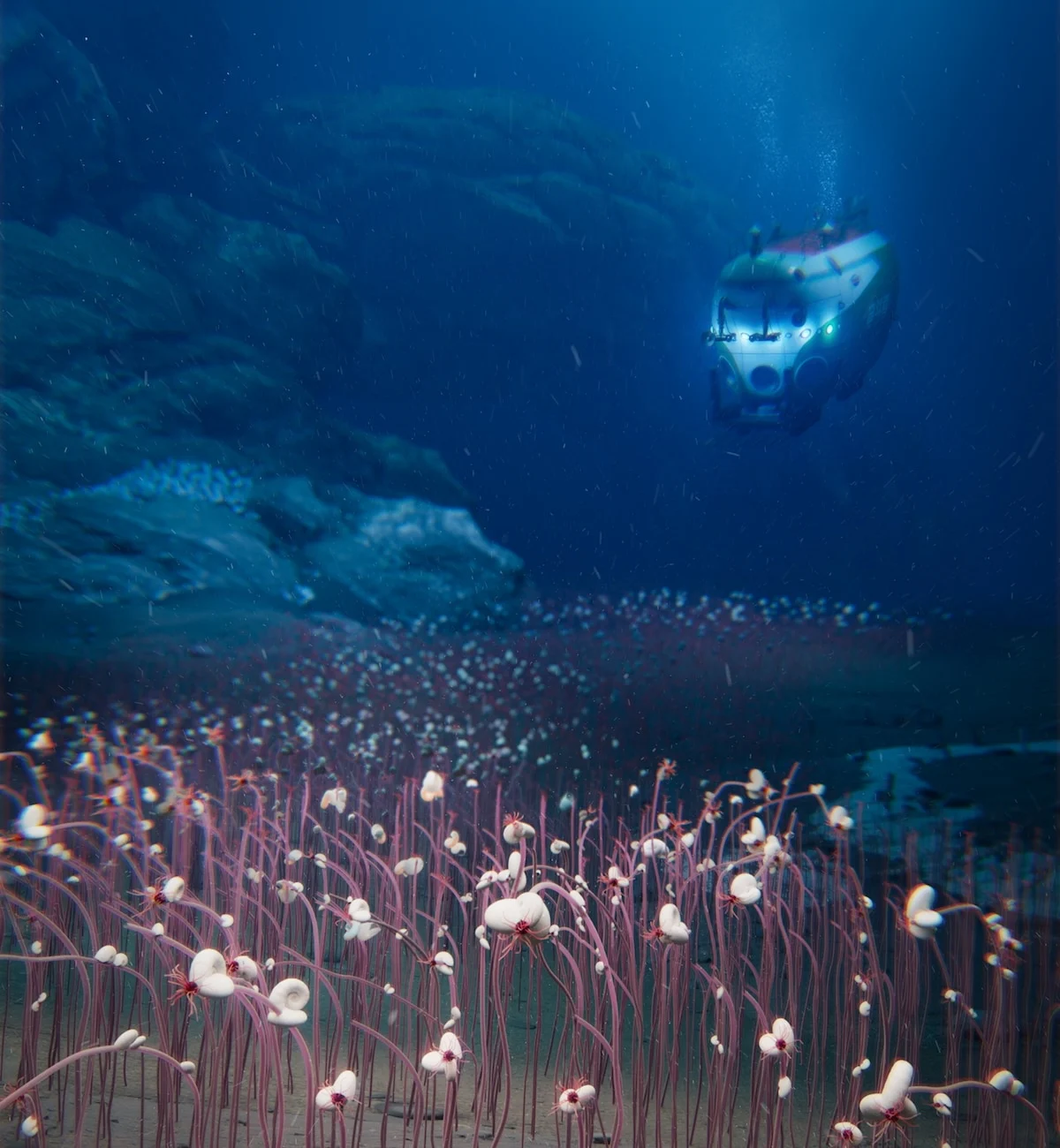
In a landmark achievement for marine biology and deep-sea exploration, a team of researchers from the Chinese Academy of Sciences has documented the deepest and most extensive animal communities ever observed on Earth. Utilizing the state-of-the-art manned submersible Fendouzhe, scientists identified vast colonies of mollusks, tubeworms, and other invertebrates thriving nearly six miles below the ocean’s surface. This discovery, centered in the Mariana Trench as well as the Kuril-Kamchatka and western Aleutian Trenches, fundamentally challenges long-standing perceptions of the hadal zone—the deepest part of the ocean—as a desolate and life-poor environment.
The findings, published in the prestigious journal Nature, detail a series of 23 dives conducted by the Fendouzhe throughout the previous year. These expeditions revealed that the deepest recesses of the planet’s crust are not merely home to isolated organisms but are instead populated by "vibrant oases" of life. Unlike the majority of life on Earth, which relies on the sun’s energy through photosynthesis, these deep-sea communities are powered by chemosynthesis, a process where organisms derive energy from chemical reactions involving methane and hydrogen sulfide.
The Discovery and Geographical Scope
The research was led by Xiatong Peng of the Institute of Deep-sea Science and Engineering (IDSSE), part of the Chinese Academy of Sciences. The team targeted the hadal trenches of the western Pacific, specifically focusing on the Mariana Trench, the Kuril-Kamchatka Trench, and the western Aleutian Trench. These areas represent some of the most extreme environments on the planet, characterized by near-freezing temperatures, total darkness, and crushing hydrostatic pressure.
The discovered communities primarily consist of siboglinid Polychaeta (tubeworms) and Bivalvia (mollusks). These populations were found spanning a staggering distance of 1,553.4 miles (approximately 2,500 kilometers) at depths ranging from 3.6 to 5.92 miles (5.8 to 9.5 kilometers). The sheer scale of these colonies suggests that such ecosystems are far more widespread than previously estimated by the scientific community.
"Given geological similarities with other hadal trenches, such chemosynthesis-based communities might be more widespread than previously anticipated," stated Peng. The documentation of these communities marks a significant shift in hadal science, moving from the study of individual specimens to the analysis of complex, interconnected ecosystems.
The Mechanism of Survival: Chemosynthesis in the Deep
At depths exceeding 6,000 meters, sunlight is entirely absent, precluding any possibility of photosynthesis. For decades, it was assumed that life at these depths depended solely on "marine snow"—organic detritus falling from the upper layers of the ocean. However, the Fendouzhe expedition has confirmed that these massive colonies are sustained by fluids rich in methane and hydrogen sulfide.
According to the study, these life-sustaining chemicals are transported along geological faults that traverse deep sediment layers in the trenches. Isotopic analysis conducted by the researchers indicates that the methane is produced microbially from organic matter deposited deep within the seafloor. This methane then seeps through cracks in the ocean floor, providing a steady energy source for specialized microbes.
These microbes form the foundation of the food web, often appearing as "snow-like microbial mats." The larger invertebrates, such as the siboglinid tubeworms—which can grow up to a foot in length—and various bivalve species, cluster around these mats. The relationship is often symbiotic, with the animals hosting the bacteria within their tissues to convert the toxic chemicals into nutrients.
Chronology of Mariana Trench Exploration
The discovery of these flourishing communities is the latest chapter in a century-long effort to understand the deepest parts of the world’s oceans. The history of exploration in the Mariana Trench provides essential context for the significance of the Fendouzhe’s findings:
- 1875: The HMS Challenger first records the depth of the Mariana Trench using a weighted sounding line, identifying the area now known as the Challenger Deep.
- 1951: The HMS Challenger II returns to the site, using sonar to more accurately map the depth at approximately 11,000 meters.
- 1960: The bathyscaphe Trieste, manned by Jacques Piccard and Don Walsh, becomes the first vessel to reach the bottom of the Challenger Deep. They observe small fish and shrimp, proving that life can exist under extreme pressure.
- 2012: Hollywood filmmaker and explorer James Cameron completes the first solo dive to the bottom of the trench in the Deepsea Challenger. He describes the environment as "desolate" and "alien," noting a lack of large biological activity.
- 2020–2024: The Chinese submersible Fendouzhe begins a series of record-breaking dives. Unlike previous brief visits, these missions focus on prolonged observation and systematic sampling, leading to the 2024 announcement of the extensive chemosynthetic communities.
Technical Specifications of the Fendouzhe Submersible
The Fendouzhe (meaning "Striver") represents the pinnacle of deep-sea engineering. Developed by the China Ship Scientific Research Center, it is designed to withstand the immense pressure of the hadal zone, which exceeds 1,000 times the atmospheric pressure at sea level.

The vehicle is equipped with high-definition cameras, robotic arms for sampling, and advanced sonar systems. Its ability to conduct multiple dives—23 in a single season—allowed the researchers to move beyond "snapshot" observations and instead map out the distribution of life across vast underwater valleys. Mengran Du, a marine geochemist and study co-author, emphasized that the submersible’s capabilities allowed them to see the trench as a "vibrant oasis" rather than a "vast desert."
"Diving in the submersible was an extraordinary experience—like traveling through time," Du remarked. "Each descent transported me to a new deep-sea realm, as if unveiling a hidden world and unraveling its mysteries."
Broader Scientific and Environmental Implications
The discovery of these communities has profound implications for our understanding of the Earth’s carbon cycle. Current models often overlook the contribution of hadal trenches to global carbon sequestration and processing. The presence of large-scale microbial methane production and its consumption by complex animal communities suggests that these trenches play a more active role in the planetary carbon budget than previously thought.
Furthermore, the study introduces new variables into the debate over deep-sea mining. As the global demand for minerals like cobalt, nickel, and manganese increases, many nations and corporations are looking toward the ocean floor. However, the discovery of fragile and highly specialized ecosystems at such extreme depths adds weight to the arguments of environmentalists and marine scientists who call for a moratorium on mining activities.
The International Seabed Authority (ISA) is currently in the process of drafting regulations for deep-sea mining. Critics argue that the "frontier" nature of the deep sea means we do not yet understand the full biological cost of disturbing the seafloor. The Fendouzhe’s findings suggest that mining-induced sediment plumes or chemical changes could devastate communities that have evolved over millennia in highly specific conditions.
Reactions from the Scientific Community
The global scientific community has reacted to the findings with a mixture of awe and caution. Many oceanographers believe this discovery is a "game-changer" for deep-sea biology. The fact that larger animals like sea lilies, sea cucumbers, and spiky crustaceans were found living alongside the chemosynthetic colonies indicates a much more complex trophic structure than was once imagined.
Dr. Mengran Du highlighted that the "astonishing abundance and diversity" of life observed is what sets this study apart from previous ventures. The documentation of free-floating marine worms and various invertebrates suggests that the hadal zone is not just a place where life survives, but where it thrives.
However, some researchers note that the presence of these communities also makes them vulnerable. Because they are confined to specific geological features like faults and methane seeps, they are "islands" of biodiversity. If these specific habitats are disturbed, the species within them—many of which may be endemic to a single trench—could face extinction before they are even fully described by science.
Future Research Directions
Following the success of the Fendouzhe missions, the Chinese Academy of Sciences and other international bodies are expected to increase their focus on the hadal zone. Future research will likely aim to:
- Genome Mapping: Sequence the DNA of these "extremophiles" to understand how they have adapted to high-pressure, low-temperature, and chemically toxic environments.
- Global Trench Comparison: Determine if similar communities exist in the South Sandwich Trench, the Peru-Chile Trench, or the Puerto Rico Trench.
- Long-term Monitoring: Establish autonomous observatories to monitor the "pulse" of these communities and how they respond to changes in ocean temperature or acidity.
The exploration of the Mariana Trench has transitioned from a race to reach the deepest point to a systematic effort to understand the biological frontier. As technology continues to bridge the gap between the surface and the abyss, the Fendouzhe’s discovery serves as a reminder that the Earth still holds vast, unexplored territories teeming with life that defies conventional biological rules. The "vibrant oases" of the deep sea are no longer a matter of theory but a documented reality, necessitating a reevaluation of how we protect and study the planet’s final frontier.