
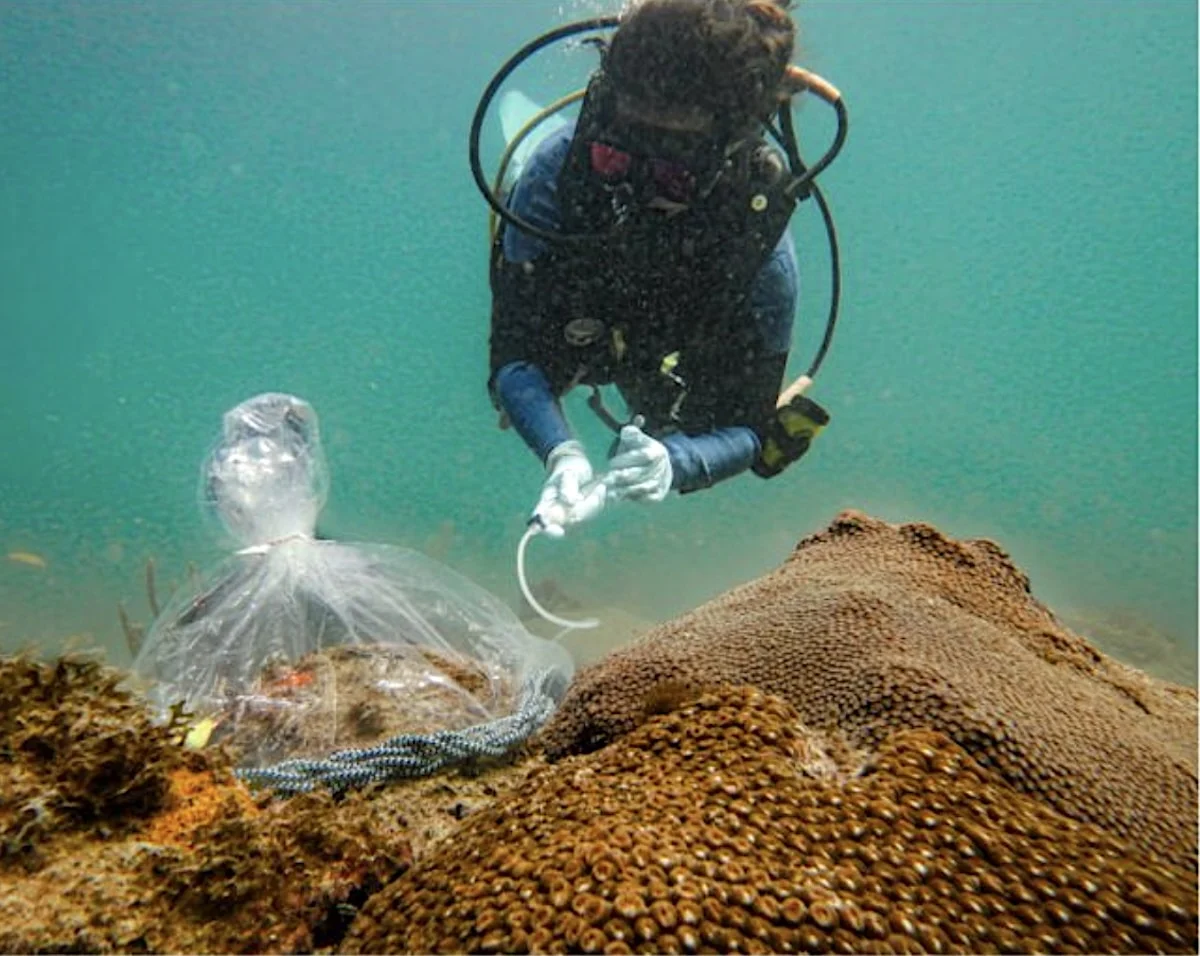
Marine conservationists have achieved a significant breakthrough in the ongoing battle to preserve Florida’s coral reefs, offering a renewed sense of optimism against one of the most destructive marine epidemics in modern history. Researchers publishing in the journal Frontiers in Marine Science have demonstrated that a specialized bacterial probiotic can effectively mitigate the devastation caused by stony coral tissue loss disease (SCTLD). By utilizing a novel whole-colony bagging technique, scientists successfully protected great star coral (Montastraea cavernosa) colonies, drastically reducing tissue loss over a multi-year monitoring period. This development marks a vital step forward in marine biotechnology, providing a potential lifeline for vulnerable reef ecosystems that face unprecedented degradation driven by warming oceans and emerging pathogens.
The Anatomy of an Ecological Crisis: Understanding Stony Coral Tissue Loss Disease
Stony coral tissue loss disease first emerged off the coast of Florida in 2014, rapidly expanding across the entire Florida Reef Tract and subsequently spreading throughout the wider Caribbean basin. Unlike routine coral bleaching episodes, which are primarily driven by elevated sea surface temperatures and can occasionally be reversed if conditions cool, SCTLD is an aggressive, waterborne pathogen—or group of pathogens—that causes rapid lesion formation and widespread tissue necrosis. Once infected, susceptible coral colonies can experience total tissue loss and mortality within weeks or months.
The disease affects more than 20 species of hard corals, which form the structural foundation of reef ecosystems. These foundational species provide critical habitats for thousands of marine organisms, protect coastal communities from storm surges and erosion, and support local economies dependent on fisheries and tourism. The relentless march of SCTLD has devastated vast swaths of coral architecture, prompting an unprecedented mobilization of marine biologists, geneticists, and conservationists working urgently to discover effective treatments before keystone species are entirely eradicated.
The Discovery of MCH1-7 and the Power of Tetrabromopyrrole
The origin of the recent breakthrough traces back to 2018, when researchers at the Smithsonian Marine Station made a pivotal discovery. While surveying reefs impacted by the epidemic, scientists identified specific coral colonies that had miraculously resisted the onslaught of SCTLD, remaining healthy despite being surrounded by infected, dying reefs. Isolating microbes from these naturally resilient organisms, the research team discovered a beneficial bacterial strain designated as MCH1-7.
Further analysis revealed that the MCH1-7 strain produces a potent natural compound known as tetrabromopyrrole (TBP). In the wild, TBP appears to play a dual ecological role. Jennifer Sneed, a biologist at the Smithsonian Marine Station, noted that TBP functions as a natural settlement cue for coral larvae, guiding them toward healthy reef environments where survival odds are higher. Crucially, the compound also exhibits robust antimicrobial properties, shielding the host coral from pathogenic microbial invasions.
Building upon previous laboratory tests that demonstrated the probiotic’s safety and efficacy on adult coral fragments, the new study sought to evaluate how MCH1-7 could be deployed practically to protect entire colonies in their natural marine habitat.
A Chronology of Innovation: From Laboratory Isolates to Field Testing
The path from discovering the MCH1-7 strain to confirming its field efficacy represents a rigorous multi-year scientific journey characterized by meticulous experimentation and field trials.
2018: Smithsonian Marine Station researchers isolate the MCH1-7 bacterial strain from a naturally SCTLD-resistant great star coral colony (Montastraea cavernosa) off the Florida coast.
2019–2021: Laboratory and controlled tank trials validate that the bacterial strain produces tetrabromopyrrole (TBP) and inhibits the progression of tissue loss in isolated coral fragments.
2022: Researchers design field methodologies to test probiotic delivery systems on wild coral colonies, comparing targeted paste applications against whole-colony containment methods.
2022–2024: A comprehensive 2.5-year monitoring phase is initiated. Scientists track disease progression, tissue retention rates, and potential ecological side effects on surrounding marine species in the Caribbean.
2025: Findings are published in Frontiers in Marine Science, detailing the superior efficacy of the whole-colony bagging technique over localized lesion pastes.
Evaluating Delivery Methods: Bagging Versus Pastes

To determine the most viable therapeutic delivery mechanism, researchers tested two distinct application strategies on great star coral colonies in the field. The first method involved applying a dense medicinal paste directly onto active disease lesions—a common practice in current coral intervention protocols. The second method utilized a novel whole-colony bagging technique, wherein a weighted, specialized bag was placed around an entire coral colony, and the probiotic compound was injected into the enclosed seawater, allowing the treatment to bathe the entire structure.
The comparative results were striking. While the direct paste application yielded limited success in halting the systemic spread of the disease across the wider colony, the whole-colony bagging technique proved exceptionally effective.
According to data cited by Mongabay News, great star coral colonies treated via the whole-colony bagging method lost an average of only 7% of their tissue to SCTLD. In stark contrast, untreated control colonies lost an average of 35% of their tissue to the disease over the same monitoring period. Furthermore, the protective benefits of the bagging treatment persisted for 2.5 years following a single application, demonstrating that the probiotic not only halts immediate disease vectors but also confers long-term disease resistance to the host organism.
Logistical Challenges and Field Implementation
Despite the clear biological advantages of the whole-colony bagging technique, marine researchers acknowledge that scaling the method presents significant logistical hurdles. Implementing the bagging protocol requires extensive scuba diving operations, precise underwater material transport, and considerably more deployment and retrieval time compared to applying a simple surface paste.
However, the research team maintains that the exceptional performance of the bagging method far outweighs its operational costs. During their field trials, the scientists also confirmed that releasing the MCH1-7 probiotic via the bagging technique did not disrupt or negatively impact other healthy Caribbean coral species or surrounding reef biodiversity, addressing a critical safety concern for open-ocean interventions.
"While the whole-colony bagging method does involve more material transport by divers and more time for deployment and retrieval, its performance at treating SCTLD and promoting long-term resistance outweigh these costs and is therefore the recommended application method of those we tested for probiotic treatments such as the McH1–7 strain," the study’s authors wrote.
Broader Implications for Marine Conservation and Future Outlook
The publication of these findings represents a milestone in active coral reef management, shifting conservation strategies from passive protection to active microbiological intervention. As global climate change accelerates ocean warming—which weakens coral immune systems and exacerbates pathogen proliferation—innovative tools like probiotic treatments are becoming indispensable components of the marine conservation toolkit.
Nevertheless, scientific leaders urge caution, emphasizing that the probiotic treatment is an emerging tool rather than a comprehensive, permanent cure for the systemic decline of global reef systems. Addressing the root causes of coral degradation requires a dual approach: combining aggressive local interventions like probiotic deployment with global reductions in greenhouse gas emissions to stabilize ocean temperatures and chemistry.
"It’s important to understand that this is the very beginning," Kelly Pitts, lead author of the study and researcher at the Smithsonian Marine Station, told Mongabay News. "This is definitely not a cure-all, but we’re definitely moving in the right direction."
As research continues, marine biologists plan to expand their investigations to test the MCH1-7 strain and related bacterial compounds on a broader array of coral species vulnerable to stony coral tissue loss disease. By refining deployment techniques and reducing logistical barriers, scientists hope to transition these promising laboratory discoveries into scalable, routine interventions capable of safeguarding the future of coral reefs for generations to come.









Leave a Reply