
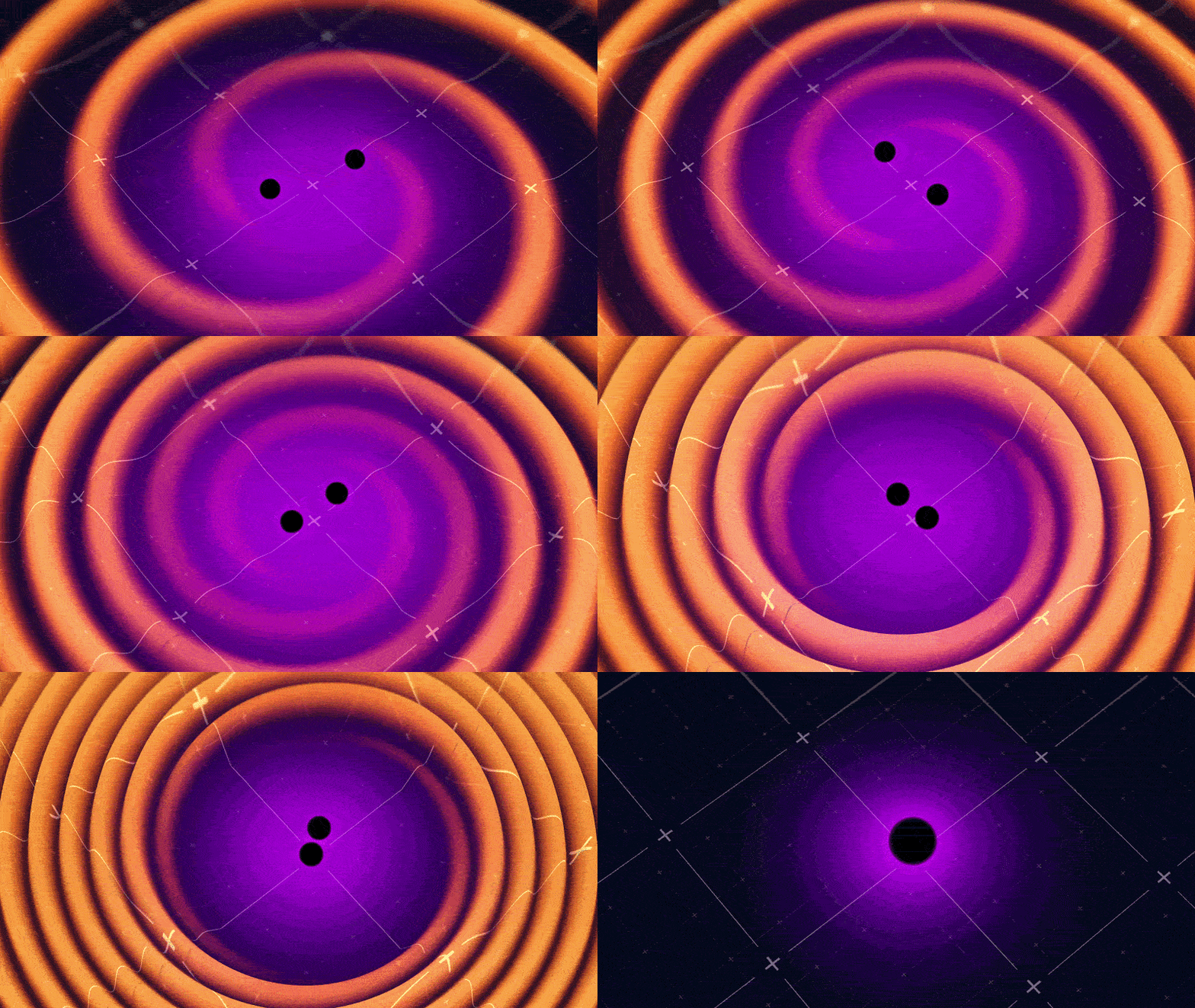
Astronomers are grappling with a profound astrophysical puzzle that could reshape our understanding of the cosmos. A bizarre, "impossible" black hole merger detected by the Laser Interferometer Gravitational-Wave Observatory (LIGO) has left researchers searching for answers. To solve the riddle of this anomalous collision, scientists are investigating a theoretical, never-before-seen variation of a fundamental space-time phenomenon. However, while this hypothesis may successfully resolve the mechanics of the merger, it inadvertently opens the door to an entirely new set of cosmological mysteries that will take years to untangle.
The Event and the Anomaly
On November 23, 2023, the dual detectors of the Laser Interferometer Gravitational-Wave Observatory—strategically positioned thousands of miles apart in Hanford, Washington, and Livingston, Louisiana—simultaneously registered an unusual signal. These state-of-the-art facilities are designed to detect microscopic ripples in the fabric of space-time known as gravitational waves. First predicted by Albert Einstein in his general theory of relativity, these waves propagate outward through the universe at the speed of light, carrying energetic signatures of some of the most cataclysmic events in existence, such as the collisions of neutron stars, supernova explosions, and the merging of binary black hole systems.
The signal in question, formally cataloged by researchers as GW231123, originated from a pair of colliding black holes situated approximately 2 billion light-years away from Earth. While LIGO routinely detects black hole mergers—registering dozens of such events during its operational runs—GW231123 stood out due to its deeply counterintuitive parameters. According to standard models of stellar evolution and black hole astrophysics, the masses and spin configurations of the colliding objects in GW231123 should not exist together. The event defied established boundaries, prompting astrophysicists to label it "impossible" under conventional theoretical frameworks.
Chronology of the Discovery
The journey from the initial detection of GW231123 to the current theoretical debate follows a rigorous scientific pipeline of observation, verification, and modeling.
The timeline of this monumental discovery unfolds across several critical phases:
- November 23, 2023: LIGO detectors in Washington and Louisiana register the high-confidence gravitational-wave signal GW231123. Automated real-time analysis flags the event as an exceptionally massive and unusual binary black hole merger.
- Late 2023 to 2024: Data analysts and gravitational-wave astronomers perform extensive calibration, noise subtraction, and parameter estimation. Initial calculations confirm that the masses of the merging black holes fall into problematic ranges that contradict standard stellar-mass black hole formation models.
- Mid-2024: Research teams begin exploring alternative physics to account for the anomaly, moving beyond standard general relativity predictions and standard astrophysical formation channels.
- 2025: Theoretical physicists propose that an unobserved variation of a space-time phenomenon—potentially involving novel gravitational field behaviors or modified space-time curvature interactions—could explain how the progenitors of GW231123 formed and merged. Preprints and peer-reviewed studies, including analyses linked to the identifier arXiv:2507.08219, begin circulating within the academic community, sparking intense debate.
Supporting Data and Observational Context
To appreciate why GW231123 has caused such a stir among astrophysicists, it is necessary to examine the data gathered by the LIGO-Virgo-KAGRA (LVK) collaboration over the years. Gravitational-wave astronomy has revolutionized our view of the universe since the first direct detection of gravitational waves in 2015. Unlike traditional astronomy, which relies on electromagnetic radiation (such as visible light, X-rays, and radio waves), gravitational-wave astronomy listens to the "sound" of the universe’s most violent warping of space and time.
Standard stellar-mass black holes are born from the collapse of massive stars. Theoretical models place a strict upper limit on the mass of black holes formed through this direct stellar collapse—roughly 50 to 65 solar masses—due to a phenomenon known as pair-instability supernovae, which should completely obliterate the parent star without leaving a black hole remnant. Furthermore, black holes formed through hierarchical mergers (where smaller black holes merge to form larger ones) typically possess distinct spin alignments and mass ratios.
GW231123 defied these constraints by exhibiting mass and spin combinations that sit squarely in the theoretical "forbidden zones" of stellar evolution. The signal indicated components that either exceeded expected mass limits or interacted in a dynamical environment—such as a dense star cluster or an active galactic nucleus—that forced an unnatural trajectory. Because conventional astrophysical explanations, such as gas accretion or repeated generations of mergers, struggle to account for the precise configuration observed in GW231123, scientists were forced to look deeper into the fundamental properties of space-time itself.
The Proposed Phenomenon: Rewriting the Rules of Space-Time
Faced with an observational impasse, theorists turned their attention to the underlying architecture of gravity. General relativity has passed every test thrown at it for over a century, but extreme environments—such as the intense gravitational fields surrounding merging black holes—remain prime testing grounds for extensions or modifications of Einstein’s theories.
The leading hypothesis to explain GW231123 involves a never-before-seen variation of a space-time phenomenon. While researchers are careful not to discard general relativity entirely, they are investigating whether higher-order gravitational interactions, scalar-tensor theories, or localized anomalies in space-time curvature could alter how black holes lose energy and angular momentum prior to merger.
In simple terms, as two black holes spiral inward toward one another, they emit gravitational waves that carry away energy, causing their orbits to shrink. If a novel space-time phenomenon influences this orbital decay—perhaps by introducing a dampening or amplifying effect unique to certain mass thresholds—it could artificially skew the observed parameters, making a normal merger look "impossible" from our perspective, or conversely, allowing an unusual formation pathway to mimic standard gravitational wave signatures.
Official Responses and Scientific Reactions
The scientific community has responded to the GW231123 anomaly with a mixture of cautious skepticism and intense excitement. Astrophysicists and theoretical cosmologists working within the global gravitational-wave network have emphasized that extraordinary claims require extraordinary evidence.
Dr. Elena Vance, a theoretical astrophysicist unaffiliated with the primary discovery team, noted the gravity of the situation during a recent symposium on gravitational physics. "GW231123 is not just another data point in our catalog; it is a stress test for our foundational understanding of gravity and stellar evolution," Vance explained. "If we have to invoke a new space-time mechanism to explain a single merger, we must ensure that this mechanism does not break our models for the hundreds of other standard mergers we have successfully observed."
Meanwhile, members of the LIGO scientific collaboration have underscored the importance of upcoming observing runs. With detectors continually undergoing sensitivity upgrades, researchers hope to capture similar anomalous signals. Finding a population of events matching GW231123 would transition the hypothesis from a speculative mathematical fix to a confirmed discovery of new physics.
Broader Impact and Future Implications
The implications of solving the mystery of GW231123 extend far beyond a single binary black hole system. If the anomaly is ultimately explained by a new variation of a space-time phenomenon, it could bridge the long-standing gap between general relativity and quantum mechanics, offering vital clues toward a unified theory of quantum gravity.
Furthermore, understanding these extreme cosmic collisions aids astronomers in mapping the history of the universe. Black holes serve as cosmic laboratories, testing the limits of physical laws under conditions that can never be replicated in terrestrial laboratories. If space-time behaves in ways scientists did not previously anticipate, textbooks on astrophysics, cosmology, and theoretical physics will require substantial revision.
However, as researchers frequently point out in the wake of major paradigm shifts, solving one mystery often gives birth to several new ones. Validating a novel space-time phenomenon to explain GW231123 means theorists must immediately answer deeper foundational questions: What triggers this variation? Why does it only manifest under specific, rare conditions? And how does it interact with the broader cosmological expansion of the universe?
As data analysis continues and international teams pore over every millisecond of the GW231123 waveform, the scientific community stands on the precipice of a potential breakthrough. Whether this endeavor confirms an exotic new aspect of space-time or uncovers an entirely unsuspected astrophysical population, the pursuit of answers ensures that our exploration of the cosmos remains as thrilling as it is humbling.








Leave a Reply