

The rapid integration of artificial intelligence into the modern workplace has triggered a paradoxical crisis: as organizations race to adopt automated tools to increase efficiency, they are simultaneously witnessing the degradation of the core human cognitive skills necessary to manage those very technologies. A comprehensive new study from the IBM Institute for Business Value, titled "Designing the Thinking Organization," reveals a growing chasm between executive expectations and employee reality regarding the shifting landscape of professional competency.
Based on extensive data collection conducted between April and June 2026, the report synthesizes insights from 1,500 CHROs and senior executives across 21 geographies and 23 industries, alongside feedback from 8,800 full-time employees. The findings suggest that while businesses are heavily focused on the technical implementation of AI, they are failing to address the "skill erosion" that occurs when human workers rely too heavily on automated outputs, potentially undermining the critical thinking and judgment required for effective corporate leadership and operations.

The Anatomy of the Disconnect
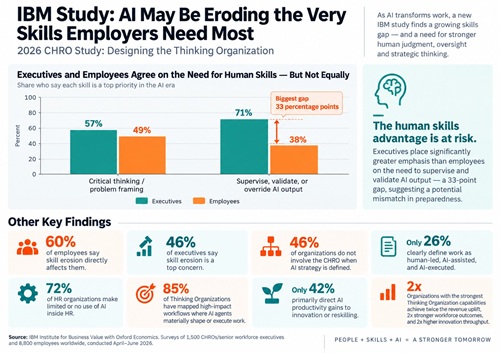
The core of the issue lies in a fundamental disagreement over what constitutes "value-add" work in an AI-augmented environment. Executives increasingly view the workforce as a system of supervisors and validators; 71% of surveyed leaders prioritize the ability of employees to supervise, validate, or override AI outputs. However, there is a stark disparity in this prioritization among the rank-and-file, with only 38% of employees identifying these oversight capabilities as a top-tier skill.
This 33-percentage-point gap indicates a misalignment in corporate strategy. While leadership views AI as a tool that requires human "guardrails," many employees are still navigating the transition from manual execution to automated assistance, often without the explicit training or clear workflow definitions required to pivot their professional identity.
The report underscores that this is not merely a "skills gap"—the traditional concept of needing to learn new tools—but a more insidious "skill erosion." When an employee stops performing a task because AI has assumed the burden of execution, the underlying cognitive muscle used to perform that task begins to atrophy. For 60% of employees, this erosion is a source of direct personal concern, with critical thinking cited as the primary casualty.
Chronology of the AI Shift
The timeline of this transition has accelerated rapidly over the last 24 months.
- Early 2025: Organizations shifted from experimental AI adoption to enterprise-wide integration, focusing primarily on productivity metrics and cost reduction.
- Late 2025: The first widespread reports of "workflow ambiguity" began to surface, as workers reported confusion over which tasks were meant to be human-led versus machine-executed.
- April–June 2026: The IBM/Oxford Economics study was conducted, providing the most granular look to date at the internal friction caused by this shift.
- Present Day: Industry leaders are now being forced to reconcile the productivity gains of AI with the potential loss of "institutional wisdom" and foundational employee expertise.
Defining the Future of Work
The IBM study highlights that 52% of employees have experienced significant changes to their daily tasks within the past year. Yet, this evolution is rarely managed through deliberate design. Only 26% of organizations have clearly categorized work into human-led, AI-assisted, and AI-executed buckets. This lack of structure means that for the majority of the global workforce, the integration of AI is happening through ad-hoc, day-to-day adaptation rather than strategic workforce planning.
This lack of definition creates a vacuum where critical thinking can suffer. When an employee is unsure if they are expected to verify a machine-generated report or simply act upon it, the default behavior often leans toward passive acceptance. This passive reliance is precisely what executives fear will lead to systemic errors, poor judgment, and an inability to handle edge cases that the AI is not equipped to process.

The Reskilling Fallacy
A significant portion of the corporate world has responded to the AI revolution by implementing reskilling roadmaps; 80% of enterprises now have such programs in place. However, the IBM report suggests these initiatives may be misdirected. Traditional reskilling focuses on acquiring new knowledge—teaching an employee how to prompt a large language model or interpret data dashboards. It does not, however, account for the loss of foundational knowledge that occurs when the "doing" is outsourced to a machine.
If an junior analyst no longer needs to manually construct a data model because an AI can generate it in seconds, they may lose the ability to spot fundamental logic errors within the data. This creates a reliance loop: the worker loses the skill, becomes more dependent on the AI, and loses the capacity to critically evaluate the AI’s output. Breaking this loop requires a fundamental redesign of work processes that emphasizes "human-in-the-loop" workflows that specifically protect and exercise critical thinking, rather than just accelerating output.
Broader Economic and Operational Implications
The implications of this skill erosion extend far beyond the HR department. For the C-suite, the concern is that the long-term viability of the organization is being compromised by short-term productivity gains. If a company loses its collective ability to exercise judgment—to look at an AI output and say, "This is technically correct but strategically unsound"—the company becomes vulnerable to systemic failures that automation cannot self-correct.

Furthermore, the data suggests that HR departments are currently under-utilized in this transition. Despite their role in talent management, CHROs are often secondary to the IT department in AI strategy discussions. This leaves a critical gap in organizational design, as the "people" component of the AI equation is treated as a downstream consequence rather than a foundational pillar.
The Path Forward
To mitigate these risks, industry analysts suggest that organizations must pivot from "AI adoption" to "AI integration strategy." This involves three key steps:
- Workflow Auditing: Clearly defining the division of labor between humans and machines, ensuring that humans retain control over high-stakes decision-making.
- Cognitive Preservation: Designing training programs that treat critical thinking as a "use it or lose it" skill, potentially by maintaining manual tasks alongside automated ones to ensure proficiency remains high.
- Value-Based Assessment: Moving beyond simple productivity metrics. Instead of measuring how much time an employee saves, companies should measure the quality and strategic depth of the work produced by the human-AI partnership.
The IBM report serves as a warning shot to leadership: the most dangerous risk in the age of artificial intelligence is not that the technology will fail to work, but that it will work so well that we forget how to work without it. As the boundary between human contribution and machine output continues to blur, the organizations that succeed will be those that view their human workforce not as a legacy component to be replaced, but as the essential, critical-thinking core that gives the technology its purpose.

The tension between efficiency and competency will remain a defining feature of the corporate landscape for the foreseeable future. The challenge for 2027 and beyond will be to ensure that the pursuit of speed does not come at the cost of the very intelligence that makes human labor indispensable. As IBM’s research confirms, the tools are ready, but the organizational structure to support them is still in its infancy, and the risk of atrophy in the workforce is a reality that can no longer be ignored.










Leave a Reply