

The rapid integration of artificial intelligence into the global workplace is fundamentally transforming the nature of human labor, yet a hidden crisis is brewing beneath the surface of productivity gains. According to a comprehensive global study released by the IBM Institute for Business Value (IBV), while artificial intelligence is redefining which human capabilities are most critical in the modern enterprise, employees are increasingly reporting that these exact cognitive faculties are actively eroding. Entitled "Designing the Thinking Organization," the report places human critical thinking, professional judgment, and the capacity to evaluate machine-generated outputs at the very center of a growing tension between corporate leadership and the workforce.
Methodology and Background of the Study
To understand the profound shifts occurring across the global economy, the IBV study was conducted in collaboration with Oxford Economics, utilizing a rigorous dual-survey methodology. Fielded between April and June 2026, the research captures insights from two distinct vantage points within the corporate ecosystem. First, researchers surveyed 1,500 Chief Human Resources Officers (CHROs) and senior executives who bear direct responsibility for organizational workforce strategy. These executives represent 21 diverse geographic regions and span 23 distinct industries, offering a macro-level perspective on enterprise transformation.

Second, the study surveyed 8,800 full-time employees across 28 countries, capturing the micro-level, day-to-day realities of workers navigating AI-augmented environments. This expansive data set allows analysts to map not only the strategic objectives of corporate leadership but also the lived experiences, anxieties, and friction points reported by the global workforce. The resulting data highlights a series of striking disconnects between how leadership envisions the future of work and how employees are experiencing the transition on the ground.
The Evolution of Daily Work and Organizational Lag
One of the most revealing findings of the IBV research is the sheer speed at which job roles are evolving compared to the pace of formal organizational redesign. More than half of the employees surveyed—precisely 52%—reported that their assigned tasks and daily responsibilities had fundamentally changed over the preceding year as AI tools reshaped their workflows.
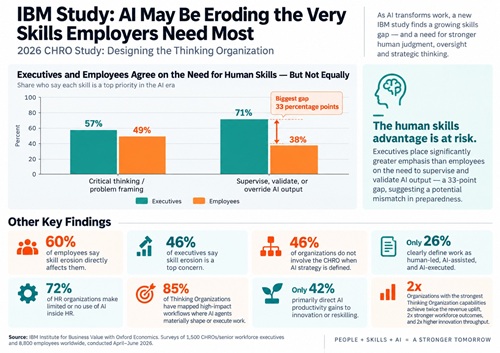
However, this organic adaptation is occurring largely in an operational vacuum. The study revealed that only 26% of organizations have clearly and formally defined their workflows across distinct categories: human-led, AI-assisted, and AI-executed activities. IBM characterizes this dynamic as a dangerous lag, wherein work is changing at a velocity far exceeding the rate at which organizations are redesigning their operational frameworks. Instead of deliberate, strategic decisions regarding how humans and artificial intelligence should collaborate, day-to-day improvisation has become the default operational mode for millions of workers.
The Executive-Employee Perception Gap on AI Oversight
As artificial intelligence shoulders a heavier burden of routine tasks, the skill sets required of human workers are shifting dramatically. However, executive expectations and employee self-assessments regarding these new competencies reveal a profound perceptual chasm.
When examining core capabilities such as critical thinking and problem framing, executive and employee priorities align relatively closely. Approximately 57% of executives and 49% of employees place these cognitive abilities near the top of the skills necessary for success in an AI-enabled workplace.
The alignment shatters, however, when examining the mechanics of AI oversight. A staggering 71% of surveyed executives prioritize the human ability to supervise, validate, or override AI outputs. In stark contrast, only 38% of employees share this priority—representing a massive 33-percentage-point gap. Furthermore, supplementary data from IBM announcements indicates that only 29% of employees actively rank professional judgment as a top-tier operational priority. This disconnect suggests that while leadership views human oversight and validation as an indispensable safeguard against algorithmic error, a significant portion of the workforce has yet to internalize the necessity of acting as an editorial and analytical gatekeeper for machine intelligence.

A Distinct Crisis: Skills Gap Versus Skill Erosion
While corporations have long grappled with the traditional "skills gap"—the challenge of training workers on emerging technologies—the IBM study brings a more insidious phenomenon to the forefront: skill erosion.
Executive leadership is acutely aware of this threat, with 46% of C-suite respondents identifying skill erosion as a top operational concern. Yet, the anxiety is felt even more acutely on the front lines, where 60% of employees report that skill erosion directly impacts them. Among this group of concerned workers, three out of four report that the deployment of artificial intelligence has already measurably diminished at least some of their core professional capabilities, with critical thinking cited most frequently as the capability in the steepest decline.
To contextualize this crisis, industry analysts emphasize that skill erosion is fundamentally distinct from a standard skills shortage. A traditional skills gap implies that workers lack knowledge they have yet to acquire. Skill erosion, conversely, describes the atrophy of existing competencies that occur when machines take over the underlying cognitive or mechanical labor, depriving human workers of the repetition and practice required to maintain proficiency.

Corporate Remediation Efforts and Strategic Shortfalls
The existence of robust corporate training programs does not automatically inoculate an organization against skill erosion. According to the IBV study, 80% of enterprises currently maintain a formal reskilling roadmap designed to help their workforce collaborate alongside advanced technology.
Nevertheless, IBM argues that these conventional reskilling initiatives are fundamentally misaligned with the nature of the problem. While reskilling programs successfully impart new capabilities that employees need to acquire, they are rarely structured to prevent the atrophy of established skills that are outsourced to automated systems. As AI systems draft memos, analyze financial models, write software code, and synthesize legal documents, human workers are increasingly relegated to the role of passive reviewers, accelerating the degradation of foundational analytical skills.
Implications for the Future of Enterprise Strategy

The findings of the "Designing the Thinking Organization" study carry profound implications for enterprise leaders, human resources professionals, and policymakers alike. As artificial intelligence transitions from an experimental novelty to core enterprise infrastructure, organizations can no longer rely on ad-hoc adaptation or assume that traditional reskilling frameworks will suffice.
For human resources executives, the data underscores an urgent mandate to redesign work architectures deliberately. Organizations must move beyond mere productivity metrics and focus on intentional job design that preserves meaningful human engagement with complex problem-solving. This includes establishing rigorous protocols for AI validation, creating structured opportunities for workers to exercise independent judgment, and developing continuous learning environments that actively combat cognitive atrophy.
Ultimately, the study suggests that the true competitive advantage in an AI-driven economy will not belong solely to the organizations that deploy the most advanced algorithms, but to those that successfully maintain and elevate human critical thinking. Without strategic intervention to protect and nurture these cognitive capabilities, enterprises risk building highly efficient automated systems atop a foundation of eroding human expertise.










Leave a Reply