

The rapid integration of artificial intelligence into the global workforce has triggered a complex paradox: while organizations are increasingly dependent on human oversight to navigate AI-driven outputs, the very skills required to provide that oversight—critical thinking, nuanced judgment, and problem framing—are simultaneously beginning to atrophy. A comprehensive study from the IBM Institute for Business Value (IBV), titled "Designing the Thinking Organization," reveals a widening disconnect between executive expectations and the lived reality of the modern employee. As AI shifts from a peripheral tool to a core component of daily operations, the workforce is finding itself in a state of flux where the pace of technological adoption is far outstripping the structural redesign of human roles.

The Anatomy of the Study and the Methodology
The findings are based on extensive data gathered between April and June 2026, a period marked by the maturation of generative AI tools across enterprise environments. IBM, in collaboration with Oxford Economics, conducted dual-track research involving 1,500 CHROs and senior executives tasked with human capital strategy, alongside 8,800 full-time employees. The sample size spans 21 geographies and 23 distinct industries, providing a representative snapshot of how AI is reshaping the global labor market.
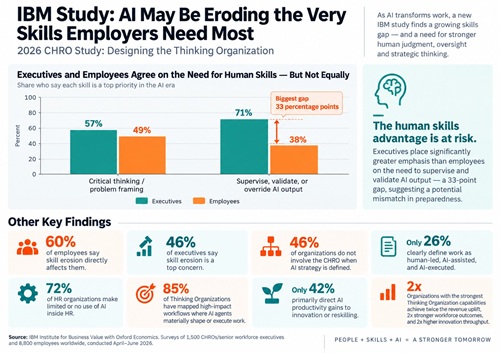
The central thesis of the report is that organizations are failing to clearly define the boundaries of human and machine labor. While 52% of employees reported a significant change in their core job responsibilities over the past year, only 26% of organizations have established clear frameworks delineating which tasks are human-led, which are AI-assisted, and which are fully AI-executed. This lack of structural clarity forces employees into a state of reactive adaptation, where they are left to navigate the division of labor on a day-to-day basis without formal guidance or strategic alignment.
The Cognitive Divide: Critical Thinking Under Pressure
Perhaps the most alarming takeaway from the research is the divergent perception of what constitutes a "critical skill" in the AI era. Both executives and employees largely agree on the theoretical importance of critical thinking; 57% of executives and 49% of employees identify it as a top-tier capability. However, the alignment breaks down when the focus shifts to the practical application of these skills, specifically in the context of auditing machine logic.
Seventy-one percent of executives state that the ability to supervise, validate, and override AI output is a critical priority for their staff. In stark contrast, only 38% of employees prioritize these same tasks. This 33-percentage-point gap suggests that while leadership is banking on human oversight to mitigate AI risks, the workforce is not being adequately trained or incentivized to assume the role of an "AI editor." Furthermore, when it comes to the nuance of human judgment, only 29% of employees rank it as a priority, indicating a potential misalignment in organizational culture regarding the value of human intuition versus automated speed.

The Emerging Crisis of Skill Erosion
The IBV study introduces a distinction between a conventional "skills gap"—the lack of new skills—and "skill erosion"—the decline of existing, high-value capabilities. This is not merely an abstract concern. Sixty percent of employees report that they are actively worried about the erosion of their professional abilities, with critical thinking being the most frequently cited casualty. Among those who express concern, three out of four report that the process of erosion has already begun, as AI assumes the foundational steps of their workflows.
Historically, reskilling initiatives have been the go-to solution for technological shifts. The IBM data suggests that 80% of enterprises have developed formal reskilling roadmaps to help employees work alongside technology. However, these programs are often designed to teach workers how to use new tools, rather than how to maintain the cognitive "muscle memory" that prevents intellectual decline. When AI handles the initial analysis, data synthesis, and formatting, the human worker is removed from the "thinking" loop, effectively losing the practice necessary to maintain high-level proficiency.
Chronology of AI Workforce Integration (2023–2026)
To understand the current state of skill erosion, it is necessary to view the rapid acceleration of AI adoption over the past several years:
- Late 2023: Initial corporate experimentation with Large Language Models (LLMs) begins, focused primarily on productivity gains and automating repetitive administrative tasks.
- Mid-2024: AI moves from "pilot project" to "operational necessity" in many sectors, including finance, legal, and software development. Organizations report productivity spikes but struggle with quality control.
- Early 2025: The first widespread reports of "AI fatigue" and over-reliance on automation surface. Enterprises begin to realize that automated outputs require more, not less, human intervention to remain accurate.
- April–June 2026: The IBM study period. Data collection reveals a systemic failure in workforce planning, where the speed of AI deployment has left human professional development in a precarious position.
Implications for the Modern Enterprise
The implications of these findings are profound. If a workforce is encouraged to outsource the "thinking" portion of their jobs to AI, the organization faces a long-term risk of "cognitive outsourcing." If the human capacity to validate and override AI output is not maintained, the enterprise becomes vulnerable to systemic errors, algorithmic bias, and a lack of creative problem-solving—traits that machines, by definition, cannot replicate.

From a human resources standpoint, the challenge is twofold. First, HR departments must transition from being facilitators of general training to becoming architects of "human-in-the-loop" workflows. This requires a granular redesign of job descriptions to ensure that humans remain the primary architects of high-stakes decision-making. Second, companies must integrate "human-centric" metrics into performance reviews. If an employee is judged solely on the speed of their output, they will naturally rely on AI to generate that output as quickly as possible. If they are judged on the quality and validity of their supervision of that AI, their professional incentives change.
Strategic Recommendations and Expert Perspectives
Industry analysts who have reviewed the IBV report suggest that the solution lies in "deliberate friction." By intentionally keeping humans in the decision-making loop, even when it might be slightly slower than a fully automated process, organizations can protect the cognitive health of their teams.

Furthermore, the data underscores a failure in executive communication. While 80% of firms claim to have a reskilling roadmap, the fact that 60% of employees feel their skills are eroding suggests that these roadmaps are either misaligned with reality or are focused on the wrong objectives. Executives must move beyond viewing AI as a mere efficiency tool and begin viewing it as a partner that requires active management. This means prioritizing the development of "meta-skills"—the ability to learn, unlearn, and critically evaluate machine-generated information—over the mastery of specific software interfaces.
As the industry looks toward the latter half of the decade, the ability of a firm to retain its competitive edge may depend less on the sophistication of its AI stack and more on the caliber of its human thinkers. If the current trajectory of skill erosion is not addressed, organizations risk creating a workforce that is technically proficient in managing tools but intellectually incapable of managing the underlying business objectives. The mandate for the next generation of leadership is clear: the organization of the future must be a "thinking organization," where technology is a catalyst for human intelligence rather than a replacement for it. The window to redesign workflows, pivot training programs, and re-emphasize the value of human judgment is narrowing, and the cost of inaction will likely be measured in diminished organizational capacity and long-term talent attrition.









Leave a Reply