
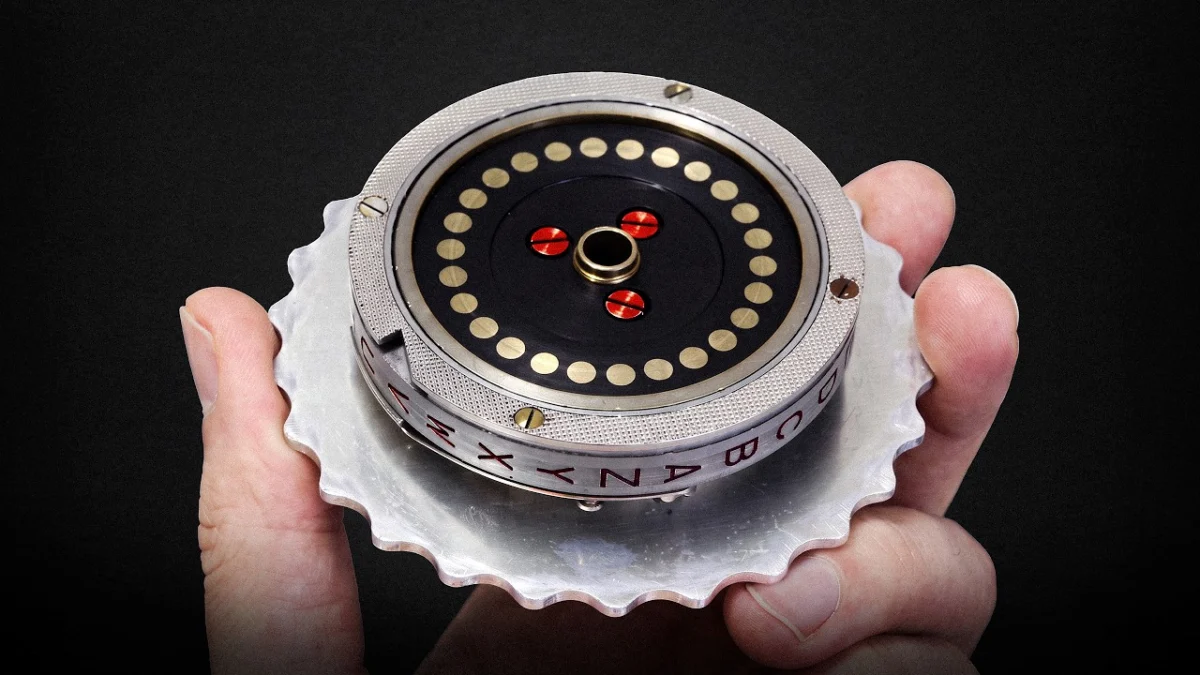
Long before it became the instrument of the most sophisticated military communications security of the Second World War, the Enigma machine was a commercially available commodity. Invented in the early 1920s by German engineer Arthur Scherbius, the device was initially marketed to banks, commercial shipping enterprises, and diplomatic agencies seeking absolute confidentiality in their daily correspondence. Any organization with sufficient financial resources could purchase a standard Enigma unit from German manufacturers, operating under the secure assumption that intercepted messages would remain entirely unreadable to outside observers.
However, the immense tactical potential of the device did not escape the attention of military strategists. By the late 1920s and early 1930s, the German armed forces—the Reichswehr, later restructured into the Wehrmacht—had adopted heavily modified versions of the Enigma machine for secure communications across the army, navy, and air force. These military iterations featured a complex array of technological upgrades that transformed a simple commercial cipher device into a formidable engine of war. When hostilities erupted in Europe in September 1939, Axis forces relied heavily on Enigma-encoded transmissions to coordinate the rapid, decentralized maneuvers that defined the military doctrine of blitzkrieg. Confident in the mathematical impregnability of their encryption systems, German command structures transmitted millions of sensitive operational orders across the European and Atlantic theaters without anticipating that the Allied intelligence apparatus could ever pierce the cryptographic veil.
Mechanics of the Enigma Machine
To comprehend the magnitude of the challenge faced by Allied codebreakers, one must examine the internal architecture of the Enigma machine itself. As demonstrated in educational analyses by scientific communicators on platforms like Veritasium, the device operated as an electromechanical substitution cipher. When an operator pressed a key on the typewriter-like keyboard, an electrical circuit was completed, sending a signal through a series of internal components that scrambled the letter into an entirely different output displayed on an illuminated board.
The cryptographic strength of the Enigma derived primarily from its revolving architecture. Each keystroke caused at least one of several interchangeable rotors—wired disks positioned inside the machine—to turn incrementally. Because these rotors rotated at different speeds, analogous to the gears in an odometer, the electrical pathway changed with every single letter typed. Consequently, typing the same letter repeatedly produced a constantly shifting sequence of substitute letters, rendering traditional frequency analysis decryption techniques nearly useless.
To compound this complexity, German military engineers introduced a telephone-operator-style plugboard on the front of the machine. By allowing operators to manually swap pairs of letters with patch cables before the electrical current even entered the rotors, the plugboard exponentially multiplied the total number of possible encryption configurations. By the outbreak of the war, German military Enigma variants permitted an astronomical $7 times 10^18$ (seven quintillion) potential settings. To human minds working manually, evaluating millions of possibilities was a physical impossibility, creating an urgent demand for advanced mathematical intervention and automated computational machinery.
The Chronology of Cryptanalytic Breakthroughs
The systematic effort to defeat the Enigma code was not born solely in Britain, nor did it begin with Alan Turing. The historical timeline of Enigma decryption spans over a decade of international mathematical collaboration, beginning deep within the intelligence corridors of interwar Europe.
In the early 1930s, French military intelligence acquired stolen technical documents detailing the commercial Enigma machine. Unable to fully reconstruct the secret military wiring from these papers alone, French intelligence shared the material with the Polish Cipher Bureau (Biuro Szyfrów). In December 1932, a brilliant twenty-seven-year-old Polish mathematician named Marian Rejewski, alongside colleagues Henryk Zygalski and Jerzy Różycki, achieved a monumental breakthrough. Utilizing advanced group theory and leveraging the sloppy operational habits of German cryptographers—who frequently repeated predictable indicator settings at the start of messages—Rejewski successfully deduced the internal wiring of the military Enigma rotors.
The Polish team subsequently engineered mechanical devices known as bomba kryptologiczna (cryptologic bombs) to automate the search for daily rotor settings. However, as the political climate deteriorated and the threat of a German invasion loomed in 1939, the Polish government shared its breakthroughs and mechanical designs with British and French intelligence representatives during a clandestine meeting in the Kabaty Woods near Warsaw.
When Poland was subsequently overrun by invading forces, the baton of cryptographic intelligence passed to the United Kingdom. British military authorities established a top-secret installation at Bletchley Park, code-named Station X, where an eclectic cohort of mathematicians, chess champions, linguists, and engineers converged to tackle the escalating cryptographic crisis. Among these recruits was Alan Turing, a visionary mathematician already renowned in academic circles for conceptualizing the "Turing machine"—a theoretical construct that laid the conceptual foundations for modern computer science.
Alan Turing and the Development of the Bombe
Arriving at Bletchley Park, Alan Turing recognized immediately that human intellect alone could not defeat the daily shifting complexities of the German military Enigma. While Polish cryptanalysts had made foundational strides, the German armed forces had significantly upgraded their security protocols by adding more rotors to choose from and expanding the plugboard combinations.
Turing approached the problem by analyzing both the structural flaws of the machine and the psychological vulnerabilities of its human operators. Mechanically, the Enigma possessed a rigid design limitation: due to its internal reflector component, the machine could never encrypt a letter as itself. A letter could never transform into its own identity in the ciphertext. Operationally, human laziness and procedural rigidity created exploitable patterns. German meteorological personnel transmitted weather reports at the exact same time every morning using standardized phrasing, and naval officers frequently prepended predictable administrative headers to their status updates.
By identifying these probabilistic fragments—known in cryptanalysis as "cribs"—Turing deduced that a non-theoretical, high-speed computational engine could systematically test thousands of potential rotor settings simultaneously. Collaborating with fellow mathematician Gordon Welchman, Turing designed the electromechanical "Bombe."
Manufactured by the British Tabulating Machine Company, the Bombe stood roughly seven feet tall and weighed approximately a ton. Operating banks of rotating drums that mirrored the internal wiring of Enigma rotors, the machine whirred and clanked through millions of potential permutations in minutes. When the Bombe identified a logical contradiction within the intercepted ciphertext based on Turing’s cribs, it halted, alerting the operator to the correct rotor settings for that specific daily schedule. Once the daily key was exposed, Bletchley Park’s analysts could rapidly decode thousands of intercepted military transmissions in real-time.
Strategic Impact and Historical Implications
The intelligence harvested from Turing’s Bombes—collectively referred to by the Allies under the codename Ultra—fundamentally altered the strategic trajectory of the Second World War. By providing Allied commanders with advance knowledge of German troop movements, supply line logistics, and submarine wolfpack coordinates, Ultra neutralized the tactical surprise that had previously granted Axis forces the upper hand.
The operational implications were profound across multiple theaters:
- The Battle of the Atlantic: Allied naval forces utilized Ultra intelligence to reroute merchant convoys away from lurking German U-boats, effectively breaking the naval blockade that threatened to starve Great Britain of vital wartime resources.
- The North African Campaign: Decrypted communications enabled British forces under General Bernard Montgomery to anticipate Axis supply vulnerabilities, culminating in decisive victories at El Alamein.
- The Normandy Landings (D-Day): Ultra intelligence verified that German high command had successfully swallowed Allied deception campaigns regarding the location of the impending cross-channel invasion, ensuring that defensive reinforcements were delayed while Allied forces established a secure beachhead in occupied France.
Historians and military analysts frequently assert that the successful cracking of the Enigma code shortened the European conflict by multiple years, sparing the lives of millions of military personnel and civilian populations.
Legacy of Bletchley Park
Despite the monumental scale of their wartime contributions, Alan Turing and his colleagues at Bletchley Park operated under the strictest levels of the Official Secrets Act. For decades following the cessation of hostilities in 1945, the existence of the Bombe machines and the scale of the decryption operations remained classified state secrets. Most of the mechanical Bombes were systematically dismantled, and their blueprints destroyed to prevent foreign intelligence agencies from replicating the technology.
It was not until the mid-1970s, with the gradual declassification of wartime archives, that the world began to understand the pivotal role played by Bletchley Park in securing Allied victory. Alan Turing himself did not live to witness public recognition of his historic achievements; targeted by mid-century British laws criminalizing homosexuality, he was convicted of gross indecency in 1952 and died tragically of cyanide poisoning in 1954 at the age of forty-one.
Decades later, the theoretical and practical foundations laid by Turing and his fellow codebreakers continue to resonate across modern society. The realization that mechanical systems could be outsmarted, dissected, and automated through logical computation paved the direct path toward the digital age. Today, as global institutions grapple with modern cybersecurity, encryption algorithms, and quantum computing frontiers, the legacy of Alan Turing stands as a testament to the transformative power of human intellect combined with the relentless pursuit of computational innovation.










Leave a Reply