
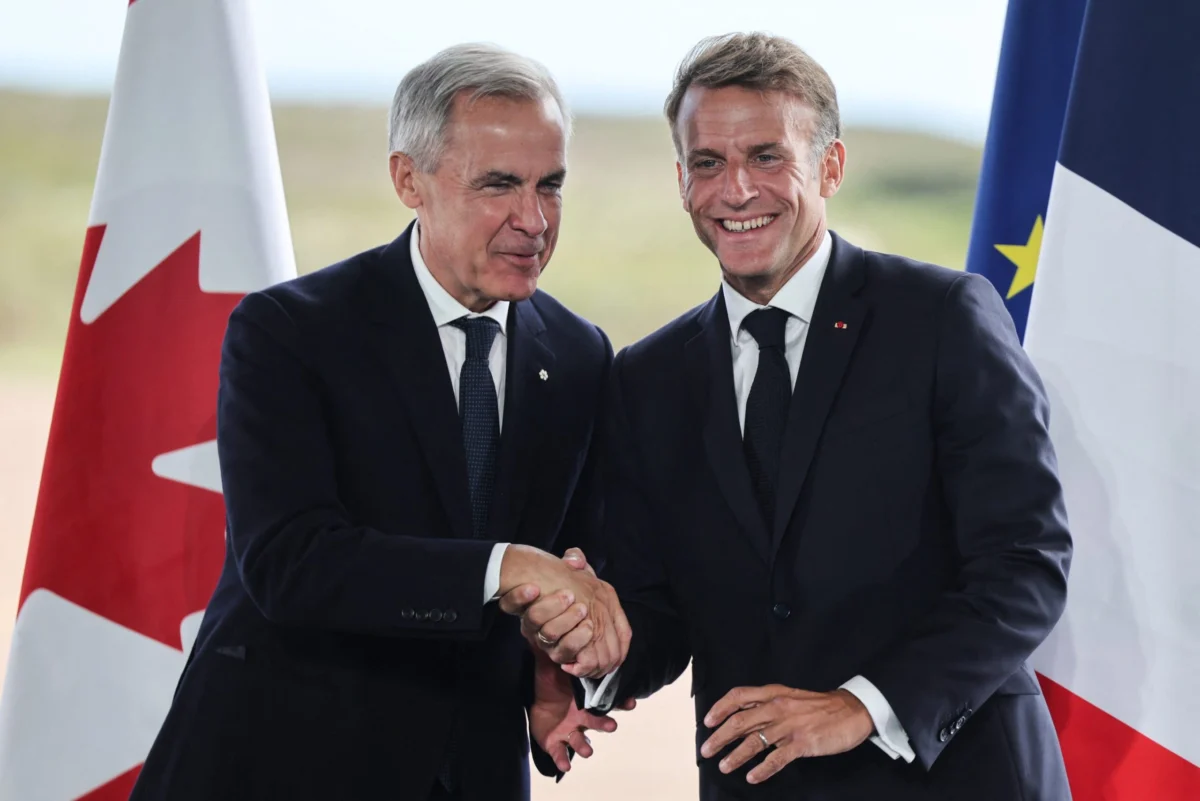
Canadian Prime Minister Mark Carney and French President Emmanuel Macron met on Sunday in the French territorial collectivity of Saint-Pierre and Miquelon to finalize a sweeping bilateral pact. The agreement establishes a framework for deeper cooperation across aerospace, defense, critical mineral supply chains, and liquefied natural gas exports. The high-stakes summit highlights a pivotal pivot in Canadian foreign and economic policy, as Ottawa accelerates efforts to diversify its international partnerships and insulate its economy from mounting pressures originating south of the border.
The meeting took place against a backdrop of escalating transatlantic trade tensions and a rapidly changing security landscape in the Arctic and Europe. Following recent policy shifts and aggressive trade postures from Washington, Canadian leadership has actively sought alternatives to its decades-old, nearly exclusive economic reliance on the United States. By aligning more closely with European powers like France, Ottawa aims to shore up its domestic resilience, safeguard its sovereign interests, and fortify supply chains critical to modern technological and industrial infrastructure.
A New Frontier in Bilateral Defense and Aerospace Collaboration
Under the terms of the newly minted agreement, Canada and France have committed to aligning their space agencies and defense ministries to share vital infrastructure. This cooperation will extend to joint launch systems, ground-based reception facilities, and collaborative satellite monitoring networks. Defense planners from both nations have been tasked with drafting operational protocols to ensure interoperability and mutual logistical support, particularly in the North Atlantic and Arctic regions, where geopolitical competition has steadily intensified.
In addition to traditional defense hardware and space exploration assets, the partnership zeroes in on advanced technology sectors. Officials confirmed that joint initiatives will encompass quantum computing, supercomputing resources, and critical earth-observation capabilities. By pooling research and development capital, Ottawa and Paris hope to maintain a technological edge in fields increasingly dominated by superpower rivals. The aerospace sectors of both countries—long characterized by individual technological prowess—are expected to integrate supply chains further, creating a unified industrial front capable of weathering external economic shocks.
Energy Security Amid Global Conflict and Market Volatility
Energy independence and resource security emerged as central pillars of Sunday’s discussions. President Macron emphasized that France and the broader European Union urgently require reliable, diversified sources of oil, natural gas, and critical minerals as the ongoing conflict involving Iran continues to disrupt global energy markets. The resulting volatility has driven up commodity prices and fueled widespread anxiety across Europe regarding the continuity of its essential supplies.
“Canada is a country with significant resources of critical minerals and rare earths. It is also a major oil and natural gas producer,” Macron stated upon his arrival in Saint-Pierre-et-Miquelon, an archipelago situated just off the southern coast of Newfoundland. “What we want to do is conclude agreements to secure more liquefied natural gas that can be shipped to Europe’s Atlantic coast.”
Canadian resources are viewed in European capitals as a stable, democratic alternative to volatile or politically compromised energy corridors. Beyond natural gas, the partnership targets Canada’s vast reserves of rare earth elements—essential components for electric vehicle batteries, renewable energy installations, and advanced electronics. By establishing predictable, long-term trade frameworks for these commodities, France and Canada hope to mitigate the risks posed by supply chain weaponization or sudden geopolitical flashpoints.
The Geopolitical Catalyst: Shifting Tensions with the United States
The acceleration of Canada-Europe ties is not occurring in a vacuum. Over the past year, trade relations between Ottawa and Washington have deteriorated significantly. The administration of U.S. President Donald Trump has implemented aggressive tariff regimes targeting Canadian goods, demanded sweeping economic concessions, and repeatedly floated provocative rhetoric regarding the annexation of Canada as the 51st U.S. state.
These persistent threats have galvanized a bipartisan consensus in Ottawa: Canada must fundamentally reduce its economic vulnerability by cultivating alternative alliances. The strategic pivot gained substantial momentum just days prior to the Saint-Pierre-et-Miquelon summit, when Prime Minister Carney publicly embraced the prospect of Canada becoming the European Union’s first associate member.
Addressing parliament, Carney argued that deeper integration with the European single market and institutional framework would render Canada immune to the economic coercion of any single hegemon. “Canada and Europe will build an alliance for the future that will strengthen our collective resilience so we can live our lives as we choose based on the values that we share,” Carney reiterated on Sunday.
This diplomatic realignment represents a historic departure from traditional North American integration frameworks, signaling that Ottawa views its long-term prosperity and security as inextricably linked to the preservation of a rules-based multilateral order shared with European democracies.
Contextualizing the Arctic and Greenland Agreements
The geopolitical calculus behind the Carney-Macron summit also reflects mounting anxieties over Arctic security. The meeting followed closely on the heels of a controversial agreement concerning Greenland, in which Washington secured an expanded military presence on the island while nominally leaving the territory under Danish sovereignty.
The Greenland deal was the culmination of months of intense pressure and threats by President Trump directed at the semiautonomous territory, prompting alarm among NATO allies regarding regional stability and the integrity of allied borders. While the resolution averted an immediate crisis, European leaders remain deeply unsettled by the precedent set during the negotiations.
Macron offered a measured response to the Greenland pact upon his arrival in the French Atlantic territory, which is home to approximately 5,800 residents. “Danish sovereignty is being respected, international law is being respected,” Macron remarked. “Anything that helps ease tensions is a good thing.”
Nonetheless, the episode served as a stark reminder to middle powers like Canada and France that traditional security guarantees cannot be taken for granted. The shared imperative to secure the Arctic rim against encroachment by rival powers—namely Russia and China—has provided additional impetus for Ottawa and Paris to synchronize their defense doctrines and operational capabilities.
Chronology of Events Leading to the Paris-Ottawa Pact
To understand the rapid trajectory of the Canada-France partnership, it is necessary to examine the sequence of diplomatic milestones that culminated in Sunday’s summit:
- Early Phase: Escalating trade friction between Ottawa and Washington prompts Canadian policymakers to quietly explore deeper economic diversification initiatives with transatlantic allies.
- Mid-Period: President Trump introduces stringent tariffs on Canadian exports and renews rhetorical attacks concerning Canadian sovereignty, catalyzing an urgent reevaluation of national security and trade dependencies in Ottawa.
- The European Pivot: Prime Minister Carney delivers a landmark speech in Parliament, formally endorsing the framework for Canada to pursue associate membership within the European Union.
- Arctic Security Flashpoint: The United States and Denmark reach a controversial accord regarding an expanded military footprint in Greenland, heightening European and Canadian sensitivities surrounding Arctic sovereignty.
- The Saint-Pierre-et-Miquelon Summit: Prime Minister Carney travels to the French territory off the coast of Newfoundland to meet with President Macron, resulting in a finalized bilateral agreement covering defense, space, energy, and critical mineral supply chains.
Fact-Based Analysis of Implications and Future Outlook
The deepening of strategic ties between Canada and France carries profound implications for international relations, transatlantic trade, and regional security dynamics.
Economically, the pivot toward Europe offers Canada a crucial buffer against unilateral trade actions from the United States. By integrating more tightly with the European single market and securing long-term export contracts for liquefied natural gas and critical minerals, Canadian industries can diversify their customer base and achieve greater price stability. For France and the broader European Union, access to Canadian natural resources provides a vital safeguard against energy shocks stemming from ongoing conflicts in the Middle East and structural dependencies on volatile suppliers.
Militarily, the collaboration in space and defense signals a maturation of middle-power cooperation. As multilateral institutions face mounting strain, nations like Canada and France are increasingly turning to bilateral and minilateral frameworks to maintain strategic autonomy. Joint infrastructure sharing in satellite communications and defense technology ensures that both countries retain independent operational capabilities in critical domains, reducing their reliance on American military oversight.
However, significant challenges remain. Deepening economic integration across the Atlantic ocean entails substantial logistical hurdles, regulatory harmonization processes, and the management of carbon-intensive supply chains in an era of stringent European environmental standards. Furthermore, managing the geopolitical fallout from Washington regarding Canada’s economic realignment will require delicate and sustained diplomatic maneuvering by Ottawa.
Ultimately, the Carney-Macron agreement marks a watershed moment in contemporary geopolitics. By formally bridging the gap between North America and Europe through targeted resource, defense, and technological alliances, Canada and France are actively redrawing the strategic map to navigate an increasingly unpredictable and fragmented global order.








Leave a Reply