
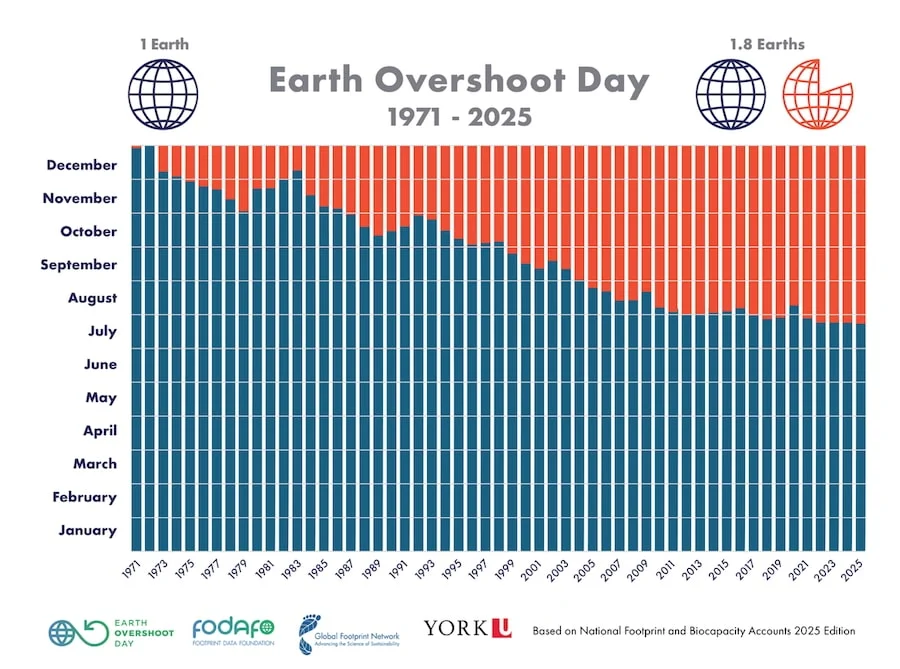
Humanity has officially reached a grim ecological milestone, exhausting the Earth’s resource budget for the year faster than at any point in recorded history. According to recent calculations released by the Global Footprint Network, Earth Overshoot Day for 2025 fell on July 24. This marks the earliest date the symbolic threshold has been reached since tracking began, surpassing previous records and underscoring a deepening ecological deficit that scientists warn is rapidly testing the boundaries of planetary survival.
Earth Overshoot Day represents the precise calendar date when humanity’s annual demand for ecological resources and services exceeds what Earth’s ecosystems can naturally regenerate within that same year. The metrics encompass a wide range of natural capital, including the consumption of freshwater, timber, and seafood, alongside the absorption of carbon emissions generated by human activity.
Presently, the Global Footprint Network calculates that the global population is operating at an unsustainable rate, utilizing nature roughly 1.8 times faster than the planet can renew its vital assets. This means humanity is effectively demanding the ecological output of 1.8 Earths to sustain current global lifestyles, industrial processes, and economic consumption patterns.
Historical Evolution and Recalculation of Overshoot
The concept of Earth Overshoot Day was first conceptualized and launched in 2006 by Andrew Simms, an author, political economist, and campaigner, in collaboration with the Global Footprint Network. Since its inception, the date has been calculated and announced annually to provide a tangible measure of humanity’s ecological footprint relative to global biocapacity.
In a recent methodological update alongside the 2025 announcement, the Global Footprint Network meticulously recalculated historical Earth Overshoot Days—extending back decades prior to 2006—to ensure greater accuracy in accounting for shifting resource use and refined data sets. These historical revisions paint a stark picture of industrial expansion and accelerating resource extraction over the last half-century.
According to these updated calculations, humanity lived within the planet’s ecological means as late as December 31 in 1972. However, as global populations grew and industrialization expanded rapidly across developing and developed nations alike, the date crept progressively earlier. By 1979, Overshoot Day arrived on November 3.
During the early 1980s, an economic slowdown briefly pushed the date back into early December. Yet, this respite was short-lived. By 1989, the date had advanced to October 12. It remained stable within the month of October throughout the entire decade of the 1990s, crossing into September for the first time in 1999, when it landed on September 25.

Entering the 21st century, the acceleration resumed at a concerning pace. When the metric was officially introduced to the public in 2006, retrospective calculations placed that year’s Overshoot Day on August 22. The trajectory continued downward until July was breached for the very first time in 2018. A brief anomaly occurred in 2020, when pandemic-related global lockdowns and economic contractions temporarily pushed the date back into August. Since 2021, however, the date has remained firmly rooted in July, culminating in the new record of July 24, 2025. This surpassed the previous earliest records of July 25, which were logged in both 2022 and 2023.
The Cumulative Deficit and Planetary Boundaries
Environmental scientists emphasize that focusing solely on the calendar date of Overshoot Day obscures a critical compounding crisis: the cumulative ecological debt humanity owes the planet. Even if global consumption patterns were to freeze at current levels, the accumulated deficit of past decades continues to mount, placing immense strain on the Earth’s life-support systems.
This systemic strain aligns closely with the framework of planetary boundaries, a scientific concept established to define the safe operating space for humanity. Recent assessments indicate that human activity has already pushed the planet beyond seven of its nine scientifically defined planetary boundaries, including climate change, biodiversity loss, land-system change, and alterations to biogeochemical flows.
Lewis Akenji, a board member of the Global Footprint Network, underscored the severity of this cumulative deficit in a public statement accompanying the 2025 data release.
"We are stretching the limits of how much ecological damage we can get away with," Akenji stated. "It is now a quarter into the 21st century and we owe the planet at least 22 years of ecological regeneration, even if we stop any further damage now. If we still want to call this planet home, this level of overshoot calls for a scale of ambition in adaptation and mitigation that should dwarf any previous historical investments we have made, for the sake of our common future."
The ecological deficit manifests visibly across the globe through chronic water scarcity, severe deforestation, depleted commercial fisheries, and an overwhelming volume of atmospheric carbon that terrestrial and marine sinks can no longer adequately sequester.
Pathways to Reversal: The Power of Possibility
Despite the sobering timeline, researchers and analysts at the Global Footprint Network stress that humanity is not locked into an irreversible trajectory. Moving Earth Overshoot Day back toward December is technically and economically feasible, provided there is sufficient political will and systemic transformation.
The organization has outlined a series of targeted, high-impact interventions under an initiative known as the "Power of Possibility" campaign. These measures demonstrate that deliberate policy choices and structural overhauls can significantly alter the global ecological footprint.

Chief among these solutions is the decarbonization of the global economy. According to network models, cutting global carbon emissions by 50% would alone push Earth Overshoot Day further into the calendar year by three months, effectively neutralizing the single largest contributor to the human ecological footprint.
Other systemic adjustments offer substantial, quantifiable delays to the overshoot date:
- Renewable Energy Transition: Generating at least 75% of the world’s electricity from renewable sources, such as wind, solar, and hydroelectric power, would push the date back by 26 days.
- Global Climate and Environmental Policy: Implementing comprehensive policy frameworks akin to a global-scale Green New Deal could shift the date by 42 days.
- Food Waste Reduction: Cutting global food waste in half from farm to table would move the date by 13 days, easing the immense agricultural, land, and water pressures required to feed a population of over eight billion people.
Choice by Design or Disaster
As policymakers, scientists, and industry leaders grapple with the implications of an ever-advancing Overshoot Day, experts reiterate that physical and ecological realities will ultimately dictate the terms of human survival. Because finite planets cannot support infinite linear growth, ecological overshoot is inherently temporary.
Mathis Wackernagel, co-founder and board member of the Global Footprint Network, highlighted the unavoidable crossroads facing global society.
"Because of the nature of physics, overshoot cannot last," Wackernagel said in a statement. "It will end either by deliberate design or dumped-on disaster. It should not be too hard to choose which one is preferable, particularly in light of so many possible choices."
The arrival of Earth Overshoot Day on July 24 serves as both an indictment of current global resource management and a persistent reminder of the tools available for correction. Whether international governance structures will leverage these solutions to achieve a managed descent from ecological overshoot remains one of the defining questions of the twenty-first century.








Leave a Reply