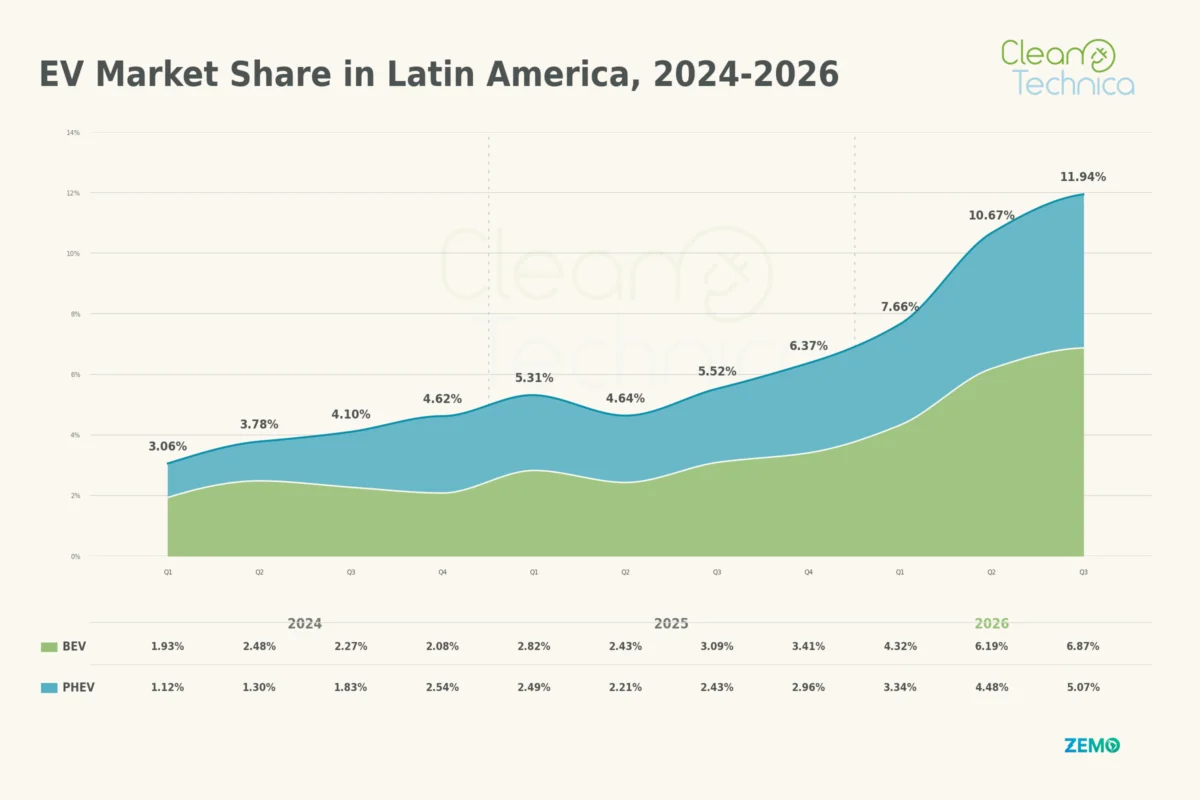
The automotive landscape across Latin America is undergoing a seismic shift as electric vehicle (EV) sales record unprecedented growth, defying regional economic challenges and signaling a definitive move away from traditional internal combustion engine (ICE) reliance. By the close of the third quarter of 2026, the region has established itself as a critical player in the global energy transition, posting a 140% year-over-year increase in EV sales. With total sales reaching 220,000 units in Q3 alone, the region is on a trajectory to exceed 700,000 units by the end of the calendar year, with optimistic projections suggesting the total could approach 800,000.
This growth is not merely a regional curiosity but a challenge to established automotive markets. For comparison, the United States recorded 266,000 EV sales during the same three-month period. Given the current velocity of adoption in Latin America, industry analysts are projecting that the region could mathematically surpass the U.S. in quarterly EV volume as early as the first quarter of 2027. While the U.S. market retains a higher proportion of battery-electric vehicles (BEVs), Latin America’s robust embrace of plug-in hybrid electric vehicles (PHEVs) has provided a bridge for consumers wary of charging infrastructure limitations, effectively accelerating the transition across diverse socioeconomic landscapes.

A Chronology of Market Acceleration
The surge observed in 2026 is the culmination of a decade-long transition. Historically, EV adoption was the exclusive domain of the world’s wealthiest nations, characterized by high subsidies and mature charging networks. However, the last three years have seen a democratization of the technology. In 2024, the region began to shed its status as a laggard, with growth rates consistently trending upward. By the second quarter of 2026, the region saw a 10.7% market share for EVs, a figure that climbed to 12% by the end of Q3.
This trajectory suggests that the region is approaching a "crossover point." As EV sales climb, the market for combustion-based powertrains—including hybrids and internal combustion engines—has begun to stagnate. In the third quarter of 2026, sales of non-electric vehicles fell by 3.7%, a decline that marks a sharp departure from the 10% annual growth rate of the overall automotive market. Economists monitoring the sector characterize this as the onset of "Peak Combustion," implying that after 2027, the dominance of fossil-fuel-dependent vehicles in the region will likely face a terminal decline.
Regional Leaders and Market Dynamics
The regional market is geographically concentrated, yet dynamic. Brazil continues to lead by a significant margin, acting as the primary engine for the region’s growth. Following Brazil are Mexico and Colombia, both of which have implemented favorable regulatory frameworks to encourage the transition.

An emerging development in late 2026 is the rise of Ecuador as a significant contender. In Q3, Ecuador saw nearly 5,000 BEV sales, a notable achievement for a country with a smaller total vehicle market. Uruguay remains the regional leader in terms of market penetration, boasting a 50.7% EV market share, with 45.7% of those sales being pure BEVs. This high adoption rate is attributed to early government incentives and a national grid powered almost entirely by renewable energy sources, which makes the transition to electric mobility a natural progression of their national energy policy.
Conversely, the market for PHEVs shows greater diversification. While Brazil remains the dominant force, Argentina, Colombia, and Ecuador have solidified their positions as top-five markets. Paraguay also entered the spotlight in Q3 2026, becoming the sixth nation in the region to achieve a double-digit quarterly EV market share, largely driven by the popularity of PHEV models.
Drivers of Adoption: Price Parity Over Fuel Costs
A common assumption in energy economics is that high gasoline prices are the primary catalyst for EV adoption. However, the data from Latin America in 2026 suggests a more nuanced reality. While countries like Panama, Paraguay, and Peru experienced fuel price hikes exceeding 50% compared to pre-2024 levels, their EV adoption rates have been inconsistent. Panama, despite the price shocks, saw a modest 57% growth in September, while Peru, despite a 270% year-over-year increase, maintains a market share of just 1.3%.

In contrast, Brazil and Colombia have maintained relatively stable fuel prices, yet they are witnessing a massive surge in EV uptake—up 160% and 190%, respectively. The critical factor, according to industry observers, is not the price of gasoline, but the "sticker price" parity between EVs and ICE vehicles.
In Brazil and Colombia, the cost of combustion-powered vehicles is high, largely due to protective tariffs designed to support local manufacturing. As EVs enter these markets at competitive price points, they become economically viable alternatives for the average consumer. In countries like Peru, however, the presence of affordable, low-cost Chinese-manufactured combustion vehicles—some priced at or below $10,000—creates a high barrier to entry for EVs. For a consumer, the long-term savings of an EV are often eclipsed by the immediate, significant savings of purchasing an ultra-affordable gas-powered vehicle.
The Role of Chinese Automotive Manufacturers
The role of Chinese brands in Latin America cannot be overstated. Manufacturers such as Changan, Jetour, Geely, and JAC have leveraged their existing supply chains to gain a foothold in the region. In Peru, these brands account for roughly 20% of the total automotive market. The current strategy for many of these firms appears to be the liquidation of combustion-engine inventory in international markets, which they are unable to move within China.

This creates a temporary market distortion: as long as high-quality, inexpensive ICE vehicles remain available from these manufacturers, the transition to EVs will be delayed in price-sensitive markets. However, as these manufacturers shift their global production focus to BEVs, this barrier is expected to dissolve, likely triggering a sharp, sudden increase in EV sales in countries that are currently lagging.
Implications and Future Outlook
The implications of this transition are far-reaching. For Latin American governments, the move toward electrification offers a way to reduce dependence on imported fuel and improve urban air quality. For the automotive industry, it represents a shift in focus toward a region that was previously considered a secondary market.
Looking toward 2027, the challenges remain significant. While the top five markets have shown strong, consistent growth, other major economies like Chile and Argentina have yet to see their BEV market share consistently exceed the 5% threshold. Furthermore, the industry is bracing for the next phase of the transition: the electrification of heavy-duty transport. While consumer vehicle adoption is accelerating, the introduction of e-trucks and electric commercial fleets is expected to become the next major hurdle between 2027 and 2028.

Industry analysts emphasize that the "bar is rising." Having surpassed the 10% market share milestone in 2026, the conversation has shifted toward the 20% mark. Achieving this will require more than just the arrival of new models; it will necessitate sustained investment in public charging infrastructure and a harmonization of regional policies that favor zero-emission vehicles.
As of late 2026, the consensus among regional automotive associations and energy policy experts is that the "tipping point" has already passed. The combination of falling battery prices, the expansion of regional manufacturing, and the inevitable decline of ICE-related government subsidies suggests that the Latin American automotive sector will continue to deviate from its historic dependence on fossil fuels. While the path to a fully electrified fleet remains long, the velocity of the current shift confirms that Latin America is no longer just a participant in the global energy transition—it is becoming a driver of it.