
Curbside food scrap collection programs have seen an unprecedented expansion across North America, yet the success of these initiatives hinges on a fundamental challenge: household consistency. While infrastructure growth has been rapid—with BioCycle’s nationwide surveys indicating that 14.9 million U.S. households gained access to food waste collection by 2023, a 49 percent increase from just two years prior—the actual utilization of these services remains highly inconsistent. In many municipalities, participation rates hover stubbornly below 30 percent, creating a significant gap between the intent of environmental policy and the reality of residential waste management.
This disparity is not merely a matter of administrative oversight; it is an environmental imperative. Food waste currently constitutes approximately 24 percent of the municipal solid waste stream in the United States. According to the Environmental Protection Agency (EPA), the anaerobic decomposition of this organic material in landfills is a primary driver of fugitive methane emissions, accounting for roughly 58 percent of all landfill-generated methane. Because methane possesses a global warming potential significantly higher than carbon dioxide over a 20-year horizon, the failure of a green bin program is not a neutral outcome—it is a lost opportunity to mitigate climate change at the municipal level.
The Evolution of Waste Diversion Infrastructure
The transition from traditional waste disposal to organized organics diversion has been a decade-long process for many urban centers. Early adopters in cities like San Francisco and Seattle paved the way, demonstrating that source-separated organics could be effectively diverted from landfills to industrial-scale composting or anaerobic digestion facilities.

In recent years, the movement has accelerated. Between 2021 and 2023, major metropolitan areas including New York City and various regions across Canada significantly scaled their organics collection mandates. However, the nomenclature remains fragmented. Whether termed the "Green Bin" (a term popularized in Toronto), "Brown Bin" (New York), or simply "Organics Cart," the operational objective remains uniform: isolating organic matter from inorganic refuse to facilitate biological recycling. Despite this standardization of goals, the "last mile" of the process—the household kitchen—remains the most significant point of failure.
Analyzing the Attrition of Participation
Field reports from sanitation departments suggest that the decline in program participation is rarely due to ideological opposition. Rather, it is driven by domestic friction. Households that initially register for organics collection often discontinue the practice due to a cumulative "yuck factor." The buildup of liquids at the bottom of collection bins, the necessity for frequent, labor-intensive cleaning, and the subsequent odor issues serve as potent disincentives.
While formal academic studies on the specific correlation between bin hygiene and program abandonment are sparse, industry data from the UK’s Essex County Council provides a compelling case study. In 2023–24, the council implemented a "Food Recycling Project" targeting 375,000 households. By providing a structural support system—including educational materials and, crucially, compostable liners to keep the bins contained—the council observed a 21 percent increase in food recycling tonnage within three months, more than double their initial 10 percent target. This evidence suggests that when the physical inconvenience of the "mess" is removed, user engagement increases commensurately.
The Mechanics of Waste Containment
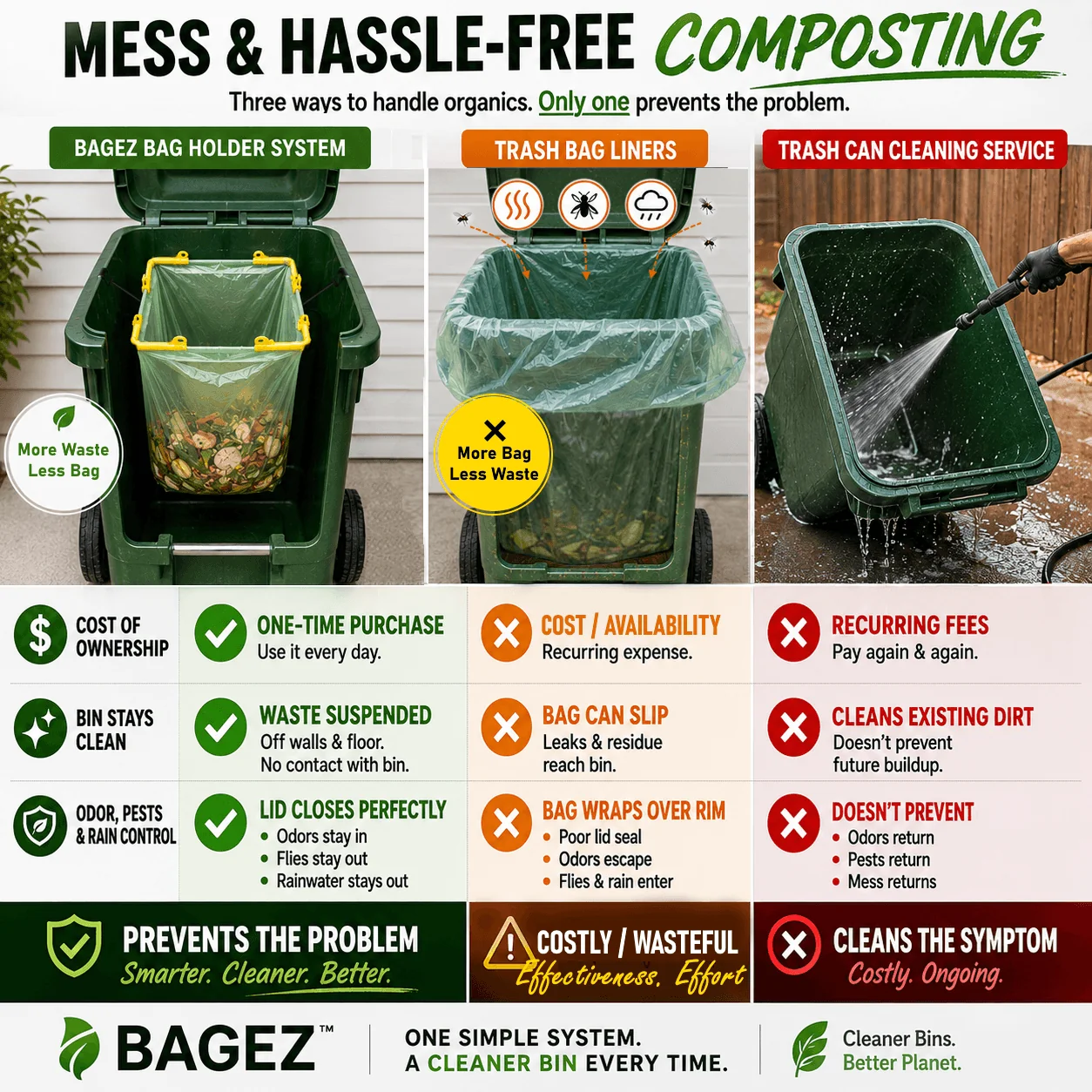
The core issue facing the average household is the biological nature of food waste. Produce and food scraps have high moisture content. As this organic matter breaks down, it releases liquids that, in the absence of a containment system, pool at the base of the curbside bin. This residue provides a breeding ground for bacteria, leading to foul odors, fruit flies, and, in warmer months, the potential for maggot infestation.

Innovative hardware solutions have emerged to address this, shifting the focus from post-collection cleaning to preventative containment. Technologies such as the BagEZ steel frame system illustrate a design shift toward "right-sizing" the containment process. By suspending a standard-sized bag within the larger curbside bin, the system ensures that waste never makes direct contact with the bin walls. This creates an air gap that allows for improved circulation, which prevents the buildup of condensation and trapped moisture.
Data from the MITRE-Gallup household food-waste study, which analyzed the habits of nearly 10,000 households, reveals that the average weekly output of food scraps is approximately 8.8 cups. This volume is significantly lower than the capacity of a standard municipal organics cart. Consequently, the reliance on massive, bin-sized liners is often inefficient and expensive. By utilizing a frame-based system, households can use smaller, more cost-effective liners that better match their actual output, while simultaneously eliminating the need for frequent bin sanitization.
Navigating Regulatory Variability
While technological interventions offer a path toward increased participation, they must be aligned with local municipal guidelines. The regulatory landscape regarding liners is highly varied. Some jurisdictions mandate certified compostable bags that meet specific ASTM standards (such as D6400), while others prohibit plastic-based liners entirely, preferring paper or loose collection to avoid contamination at the composting facility.
The risks of non-compliance are high; if a haulage company detects "contaminated" material—such as a non-compostable plastic bag—they may skip the collection, leading to further frustration and potential program withdrawal by the resident. Residents are encouraged to consult resources such as Earth911’s recycling database before adopting any new containment strategy to ensure their method of collection aligns with the requirements of their specific regional waste processor.

Strategic Implications for Municipalities
For municipal waste authorities, the implications of these findings are clear: technical infrastructure must be supported by user-experience improvements. If the objective is to reduce the 24 percent of landfill mass currently occupied by food waste, the barrier to entry must be lowered.
- Containment over Cleaning: Programs that provide or incentivize the use of internal bag-hanging systems or high-quality liners see higher retention rates.
- Odor Mitigation: Techniques such as the application of food-grade diatomaceous earth to manage larvae, or the use of natural repellents like peppermint and clove sachets, are only effective if the bin remains dry.
- Behavioral Nudges: The Essex County model confirms that providing the tools for success—even something as simple as a liner or a bag-hanging frame—creates a positive feedback loop that increases compliance without requiring additional tax-funded infrastructure expansion.
Future Outlook
As cities continue to face pressure to meet zero-waste targets and reduce methane emissions, the conversation is shifting from "collection availability" to "collection efficacy." The "yuck factor" is no longer just a household grievance; it is a systemic obstacle to environmental policy success.
By addressing the logistical challenges of waste storage—specifically by preventing the contact between organic waste and the bin itself—households can maintain their participation with minimal effort. The transition to a sustainable waste-management future will likely require a combination of municipal policy, public education, and individual household adoption of simple, efficient tools that make the separation of organics as seamless as traditional recycling.
As of mid-2026, the industry consensus remains that while the infrastructure for organic diversion is largely in place, the path to meaningful, long-term impact lies in the small, daily choices made in the kitchen. When the process of recycling food waste becomes a matter of habit rather than a chore, the environmental benefits—ranging from reduced landfill reliance to decreased greenhouse gas emissions—can finally be realized at scale. For the individual household, the solution is increasingly found in the simplicity of keeping the bin clean, dry, and contained.









Leave a Reply