Scientists have proposed the development of a revolutionary tabletop quantum sensor capable of detecting the subtle, twisting effect that Earth’s daily rotation exerts on the fabric of the cosmos. Predicted over a century ago by Albert Einstein’s theory of general relativity, this phenomenon—known as frame dragging—has traditionally required massive, decades-long satellite missions to observe. However, a new study suggests that advanced quantum technology could soon replicate the precision of these orbital observatories in a matter of minutes, right here on the ground.
If successfully constructed and implemented, this innovative sensor would mark a monumental leap forward in experimental physics. By shrinking the scale of detection from the expanse of low-Earth orbit down to the confines of a laboratory workbench, researchers could unlock unprecedented opportunities to study fundamental physics, test the boundaries of general relativity, and probe the complex interactions between gravity and quantum mechanics.
Understanding Frame Dragging and the Lense-Thirring Effect
To comprehend the significance of this proposed device, one must first understand the nature of gravity as described by Einstein’s general theory of relativity, published in 1915. Unlike Isaac Newton’s classical view of gravity as an invisible force pulling objects together, Einstein conceptualized gravity as the curvature of space-time caused by mass and energy. Heavy celestial bodies like planets and stars warp the four-dimensional continuum of space and time around them, much like a heavy bowling ball resting on a stretched trampoline.
When a massive object rotates, it does something even more extraordinary: it drags the very fabric of space-time along with it. As Earth spins on its axis once every 24 hours, it acts like a rotating sphere submerged in thick syrup, twisting space-time into a vortex-like swirl. This phenomenon is formally known as the Lense-Thirring effect, named after Austrian physicists Josef Lense and Hans Thirring, who first derived it in 1918.
While the mathematics behind frame dragging are well-established, observing the effect experimentally has proven exceptionally difficult because it is extraordinarily weak. Earth is massive, but its rotation is not fast enough to create a space-time vortex that is easily perceptible. To detect such a minute disturbance, scientists have previously had to rely on specialized spacecraft equipped with state-of-the-art instrumentation, orbiting high above the atmospheric interference of the planet.
A Chronology of Space-Time Exploration
The pursuit of empirical proof for frame dragging has a storied history in modern astrophysics, characterized by incremental technological advancements and decades of patient data collection.

In the late 20th and early 21st centuries, space agencies recognized that confirming Lense-Thirring precession would require unprecedented navigational precision. The first major milestone arrived with NASA’s LAGEOS (Laser Geodynamics Satellite) missions, launched in 1976 and 1992. These passive, dense metallic spheres relied on ground-based laser ranging to track their precise orbital paths. By analyzing tiny perturbations in the orbits of LAGEOS-1 and LAGEOS-2 over many years, researchers were able to detect indirect evidence of frame dragging by the late 1990s and early 2000s, though the measurements carried significant margins of error due to external gravitational perturbations from Earth’s uneven mass distribution.
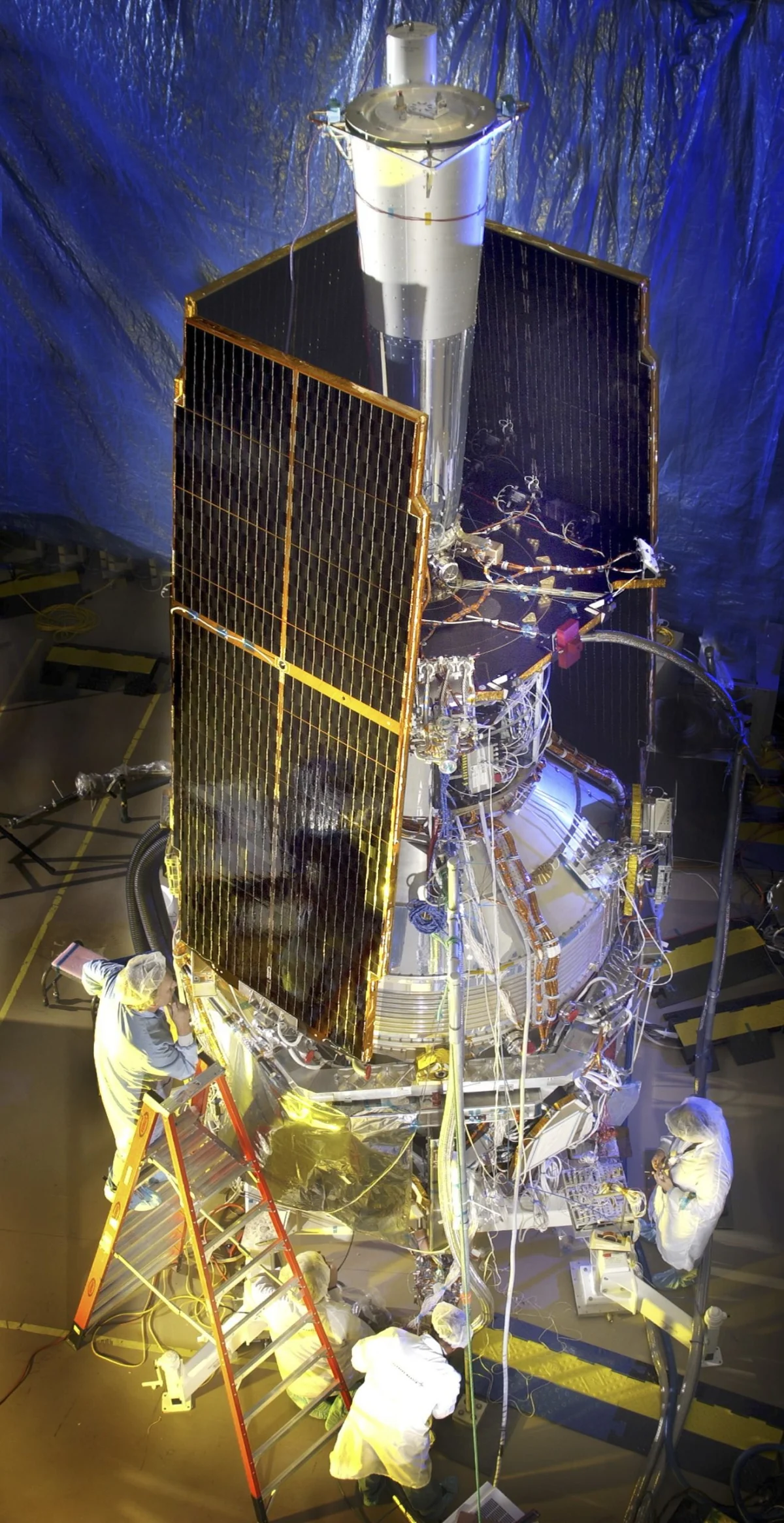
The definitive space-based validation came via NASA’s Gravity Probe B (GP-B) mission, launched in April 2004. GP-B utilized four ultra-precise quartz gyroscopes housed in a liquid-helium dewar to measure the geodetic effect (the curvature of space-time due to Earth’s mass) and the frame-dragging effect (the twisting of space-time due to Earth’s rotation). After years of meticulous data analysis, the GP-B team announced in May 2011 that the mission had successfully confirmed frame dragging with an error margin of about 0.2 percent.
However, missions like Gravity Probe B and the subsequent European Space Agency (ESA) LARES (Laser Relativity Satellite) missions required years of planning, billions of dollars in funding, and extended observation periods spanning multiple years to extract the faint signal from background noise. The newly proposed quantum tabletop device aims to bypass these logistical bottlenecks entirely.
The Mechanics of the Proposed Quantum Sensor
The newly conceptualized device leverages the principles of quantum mechanics rather than classical mechanics or orbital dynamics. While traditional gyroscopes rely on spinning mechanical parts to maintain an orientation in space, advanced quantum sensors utilize ultra-cold atoms, atom interferometry, or superconducting circuits to measure rotational forces with extreme sensitivity.
In quantum atom interferometry, clouds of atoms—typically rubidium or cesium—are cooled to near absolute zero using lasers and magnetic fields. Once the atoms are slowed down to a near standstill, laser pulses are used to split their matter waves, send them along different trajectories, and then recombine them. Because quantum particles are profoundly sensitive to external forces and fields, any minute rotation of the laboratory frame—including the subtle frame-dragging twist imparted by Earth’s rotation—will alter the phase of the matter waves.
By measuring these phase shifts with exquisite precision, the proposed device can deduce the exact magnitude of the frame-dragging effect. According to the study’s authors, this quantum approach eliminates many of the systematic errors that plague satellite missions, such as fluctuations in Earth’s upper atmosphere, solar radiation pressure, and irregularities in the planet’s gravitational field known as geoid anomalies.
Expert Perspectives and Scholarly Reception
The scientific community has responded to the proposal with a mixture of cautious optimism and profound scientific intrigue. While experimental physicists have acknowledged the immense technical hurdles involved in isolating a quantum sensor from ambient seismic and electromagnetic noise, many agree that the theoretical framework is sound.

"The prospect of bringing general relativity tests from outer space down to a tabletop environment represents a paradigm shift in how we approach fundamental physics," notes a prominent researcher familiar with advanced quantum sensing initiatives, who spoke on the condition of anonymity prior to formal peer review implementation. "If these sensitivity levels can be achieved in a controlled laboratory setting, it democratizes access to gravitational physics. We would no longer be entirely dependent on multi-year, multi-billion-dollar satellite programs to probe the boundaries of Einstein’s universe."
Other physicists emphasize that the technology required to build such a sensor is advancing rapidly, driven largely by commercial and defense investments in quantum navigation, inertial sensing, and secure quantum communications. The components needed—such as high-stability lasers, ultra-high vacuum chambers, and precision magnetic shielding—are already operational in leading-edge quantum laboratories around the globe, though integrating them into a unified system capable of measuring Earth’s space-time vortex remains a formidable engineering challenge.
Broader Implications for Physics and Technology
The implications of successfully developing a tabletop frame-dragging sensor extend far beyond merely confirming general relativity once more. First and foremost, such a device would serve as a robust testbed for unifying general relativity with quantum mechanics—the two great, yet fundamentally incompatible, pillars of modern physics. While general relativity governs the smooth, continuous macro-cosmos of gravity and spacetime, quantum mechanics dictates the discrete, probabilistic micro-cosmos of subatomic particles. Finding ways to observe quantum phenomena responding to gravitational spacetime curvature offers vital experimental clues for theories of quantum gravity, such as string theory or loop quantum gravity.
Furthermore, the technology developed to detect frame-dragging could have profound practical applications in navigation and geophysics. Ultra-sensitive quantum gyroscopes and inertial sensors are currently being developed for GPS-denied navigation systems, allowing submarines, aircraft, and autonomous vehicles to navigate with pinpoint accuracy without relying on satellite signals. In geophysics, portable high-precision gravity and rotation sensors could be deployed to monitor underground magma chambers, predict volcanic eruptions, map tectonic plate movements, and locate subterranean reservoirs of water or natural resources with unprecedented resolution.
Looking Ahead: The Road to the Laboratory
While the theoretical groundwork has been laid in the recent study, translating the proposal into an operational laboratory instrument will require significant time, funding, and collaborative engineering. Researchers must design advanced isolation systems to shield the fragile quantum states from thermal fluctuations, seismic tremors from passing traffic or ocean waves, and stray magnetic fields.
Nevertheless, the prospect of measuring the rotation of our entire planet—and its ghostly drag on the cosmic fabric—using a device that could fit on an ordinary optical table is a testament to the astonishing progress of modern quantum science. As researchers continue to push the boundaries of sensitivity and control, the invisible, twisting rivers of space-time predicted by Einstein may soon be measured not by distant spacecraft orbiting in the cold void of space, but by sensitive quantum instruments humming quietly in laboratories on Earth.