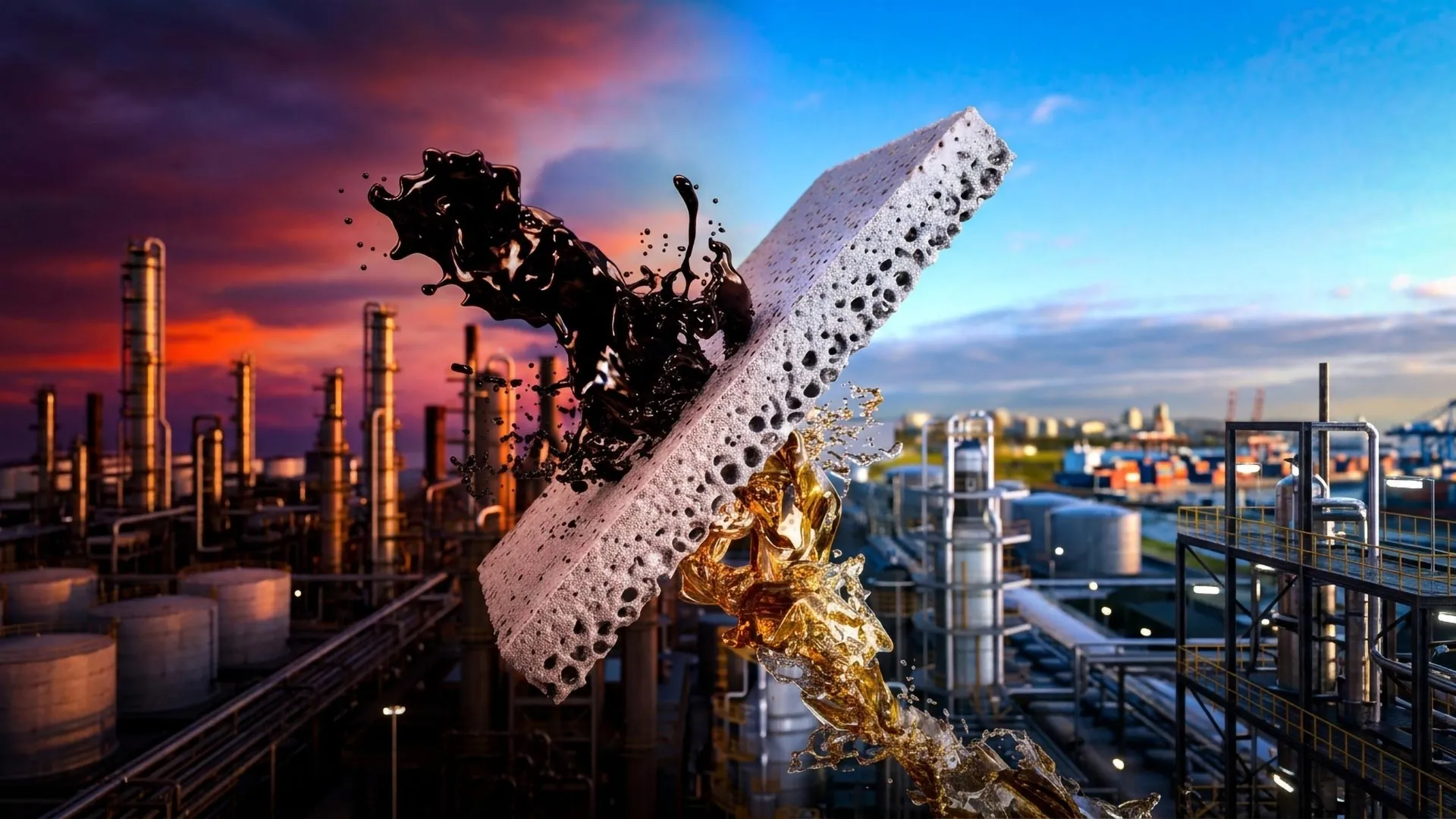
In a significant leap forward for industrial sustainability, an international team of researchers has unveiled a breakthrough method for separating crude oil that bypasses the need for high-temperature distillation. By utilizing an inexpensive, self-adjusting membrane, the research team—led by Professor Dong-Yeun Koh of the Korea Advanced Institute of Science and Technology (KAIST) in collaboration with Professor Ryan Lively’s group at the Georgia Institute of Technology—has demonstrated a process capable of refining oil at room temperature. Published in the journal Nature, this innovation addresses one of the most carbon-intensive processes in the global economy, offering a potential path toward a 31.6% reduction in energy consumption for the petrochemical sector.
The Problem: A Century of Energy-Intensive Refining
For over 100 years, the backbone of the global energy and manufacturing sector has been thermal distillation. This process is fundamentally predicated on the boiling points of different hydrocarbon fractions. To isolate gasoline, naphtha, and kerosene from raw crude, refineries must heat the oil to temperatures exceeding 350°C. Once vaporized, the components are condensed back into liquids in a massive, energy-demanding cycle.
The scale of this operation is staggering. Globally, crude oil distillation is estimated to consume approximately 1,100 terawatt-hours (TWh) of energy every year. To put this figure into perspective, this is equivalent to the annual electricity output of 130 one-gigawatt nuclear power plants. Beyond the sheer electricity demand, the combustion of fuels to maintain these extreme temperatures makes the refining industry a primary source of industrial greenhouse gas emissions. As global climate targets tighten, the reliance on century-old thermal methods has become a significant economic and environmental liability.
A Paradigm Shift: Turning "Fouling" into an Advantage
The search for alternatives has long focused on membrane filtration. In theory, membranes act as molecular sieves, separating components based on size rather than volatility. However, the path to implementation has been blocked by two major hurdles: high costs and the "fouling" phenomenon.
Conventional wisdom in material science suggested that effective molecular separation required membranes to be treated with extremely thin, high-precision coatings. These coatings are not only expensive to synthesize but are also prone to microscopic defects during large-scale manufacturing, leading to poor performance and inconsistent output.
The KAIST-Georgia Tech research team challenged this convention by employing a bare, uncoated membrane made from polyacrylonitrile (PAN). PAN is a widely available, chemically stable polymer typically used as a support structure rather than the active filtering layer in industrial systems. The breakthrough occurred when the researchers observed the interaction between the crude oil and the porous membrane.
As the raw crude flowed through the PAN membrane, heavier hydrocarbon molecules began to adhere to the internal walls of the membrane pores. Rather than causing a failure—a process known as fouling that usually necessitates immediate cleaning—this buildup acted as a self-assembling architectural tool. The accumulation of heavy molecules effectively narrowed the pores to less than 2 nanometers in diameter. In essence, the crude oil itself created the microscopic, highly precise channels required to filter its own lighter, valuable components.
Performance Metrics and Experimental Validation
The results of this self-assembly mechanism were dramatic. The uncoated PAN membrane achieved crude oil permeation rates roughly 23 times higher than those recorded for previous experimental membranes designed for similar tasks. The system demonstrated remarkable resilience, maintaining stable performance for 28 consecutive days of continuous operation.
Professor Ryan Lively of Georgia Tech highlighted the industrial relevance of these findings, noting that previous membrane designs suffered from low productivity, making them unsuitable for the massive throughput requirements of a commercial refinery. The PAN-based mechanism, by contrast, creates high-flux pathways that provide the productivity levels necessary for industry stakeholders to seriously evaluate the technology for commercial integration.
To ensure the technology was ready for real-world scenarios, the team utilized actual crude oil supplied by HD Hyundai Oilbank. This was a critical step in the research timeline, as it allowed the team to test the membrane’s durability against the complex, heterogeneous mixture of hydrocarbons found in industrial-grade feedstocks, rather than relying on simplified, synthetic laboratory samples.
Economic and Environmental Implications
The potential for widespread adoption rests on the fact that this technology does not require a complete overhaul of existing refinery infrastructure. Instead, the membrane modules could be integrated as a pre-treatment stage, processing crude oil before it enters the traditional distillation tower. This "hybrid" approach would significantly reduce the thermal load on the distillation columns, lowering the amount of energy required to reach the target temperatures.
The environmental projections, calculated through rigorous computer simulations, are substantial:
- Energy Consumption: A reduction of 31.6% in the energy required for the refining process.
- Carbon Emissions: A decrease of 37.6% in CO2 emissions associated with distillation.
- Operational Costs: A 36% reduction in overall operating costs.
- Resource Management: A 20.7% reduction in cooling water consumption.
If deployed across the entire South Korean refining and petrochemical industry, the researchers estimate that this technology could prevent approximately 10 million tonnes of greenhouse gas emissions annually. This volume is roughly equivalent to the emissions produced by four million internal combustion engine vehicles, representing a significant contribution to national and global carbon neutrality goals.
Beyond Petroleum: Future Applications
While the primary focus of the research was crude oil, the underlying principle—using a mixture to spontaneously form its own separation pathways within a membrane—has far-reaching implications for other chemical processes.
The researchers have identified several immediate areas for future development:
- Plastic Recycling: The membrane could prove instrumental in the purification of pyrolysis oil, a product derived from breaking down waste plastics.
- Battery Manufacturing: The recovery and purification of solvents used in the production of lithium-ion batteries represent a growing industrial need.
- Pharmaceuticals and Biofuels: The precision of the 2-nanometer channels could be refined for the purification of complex organic compounds and the processing of sustainable biofuels.
The Path to Commercialization
Despite the promising results, the research team is moving forward with a measured approach to scaling the technology. The current phase of the research, as noted by co-corresponding author Professor Jae W. Lee of KAIST, involves advancing large-area membrane modularization and ensuring long-term operational reliability. The goal is to move from laboratory-scale success to industrial-scale pilot programs.
Dr. Jihoon Choi and Dr. Hyeokjun Seo, the study’s co-first authors, emphasized that the ultimate objective is to develop a robust platform that can be tuned to control the "pore-constriction" phenomenon precisely. By mastering this control, they hope to make the technology a standard tool for various sustainable chemical processes.
The project, which received support from the South Korean Ministry of Science and ICT, has established a new scientific principle for membrane science. By proving that complex mixtures can be used to improve the filtration medium rather than simply clogging it, the researchers have opened a door to a new era of "intelligent" filtration. As the energy industry faces increasing pressure to decarbonize, this simple, low-cost, and highly efficient solution offers a tangible pathway toward a cleaner industrial future. With ongoing efforts to refine the technology for broader applications, the collaborative work between KAIST and Georgia Tech stands as a testament to how fundamental scientific curiosity can yield solutions to the world’s most pressing industrial challenges.