The expansion of municipal curbside organics collection has been one of the most rapid shifts in urban waste management in the last decade. Data from the industry publication BioCycle reveals a staggering 49 percent increase in U.S. household access to food waste collection between 2021 and 2023, rising from 10 million to 14.9 million households. Yet, this logistical success masks a persistent, unglamorous problem that threatens the long-term viability of these programs: the "yuck factor." As municipalities push to divert food scraps from landfills to composting and anaerobic digestion facilities, the reality of the curbside bin—often sticky, odorous, and prone to pest infestations—is leading to significant participant attrition.
The environmental stakes are high. According to the U.S. Environmental Protection Agency (EPA), food waste constitutes approximately 24 percent of the material sent to municipal landfills. Once in a landfill environment, this organic matter decomposes anaerobically, generating methane—a greenhouse gas with a global warming potential significantly higher than carbon dioxide. The EPA estimates that food waste accounts for 58 percent of the fugitive methane emissions from municipal solid waste landfills. Consequently, an underutilized green bin is not merely a failed public utility; it is a missed opportunity to mitigate a major driver of climate change.
A Chronology of the Organics Movement
The transition toward mandatory organics recycling began in earnest in the early 2010s, primarily in jurisdictions with aggressive climate goals, such as San Francisco, Seattle, and Toronto. These early adopters treated organics as a mandatory stream, similar to paper or glass.

By 2018, the conversation shifted from regional mandates to national policy frameworks. As states like California, Vermont, and Massachusetts began implementing bans on organic waste in landfills, municipalities were forced to scale their collection infrastructure. By 2023, the rapid deployment of these programs encountered a behavioral bottleneck. While cities like Portland, Oregon, report high engagement due to long-standing cultural norms, newer programs in the Midwest and South have reported participation rates plummeting below 30 percent within the first year. Industry analysts note that while initial enrollment is often bolstered by municipal outreach and the provision of bins, sustained usage drops sharply when residents encounter the realities of maintaining an outdoor vessel for rotting food.
The Behavioral Economics of Bin Maintenance
The decline in participation is rarely due to a lack of environmental awareness; rather, it is a failure of convenience. Public health studies and municipal surveys suggest that the primary drivers for program abandonment include confusion over acceptable materials, inconvenience, and, most notably, the maintenance burden.
In 2023, the Essex County Council in the United Kingdom launched a large-scale intervention titled the Food Recycling Project. Recognizing that residents were struggling with the logistics of waste containment, the council provided 375,000 households with a comprehensive toolkit: clear signage for the general waste bin, an educational leaflet, and, crucially, a supply of compostable liners. The results were striking. In the three months following the distribution of these resources, food recycling tonnage in the target areas increased by an average of 21 percent—more than double the council’s initial target of 10 percent.
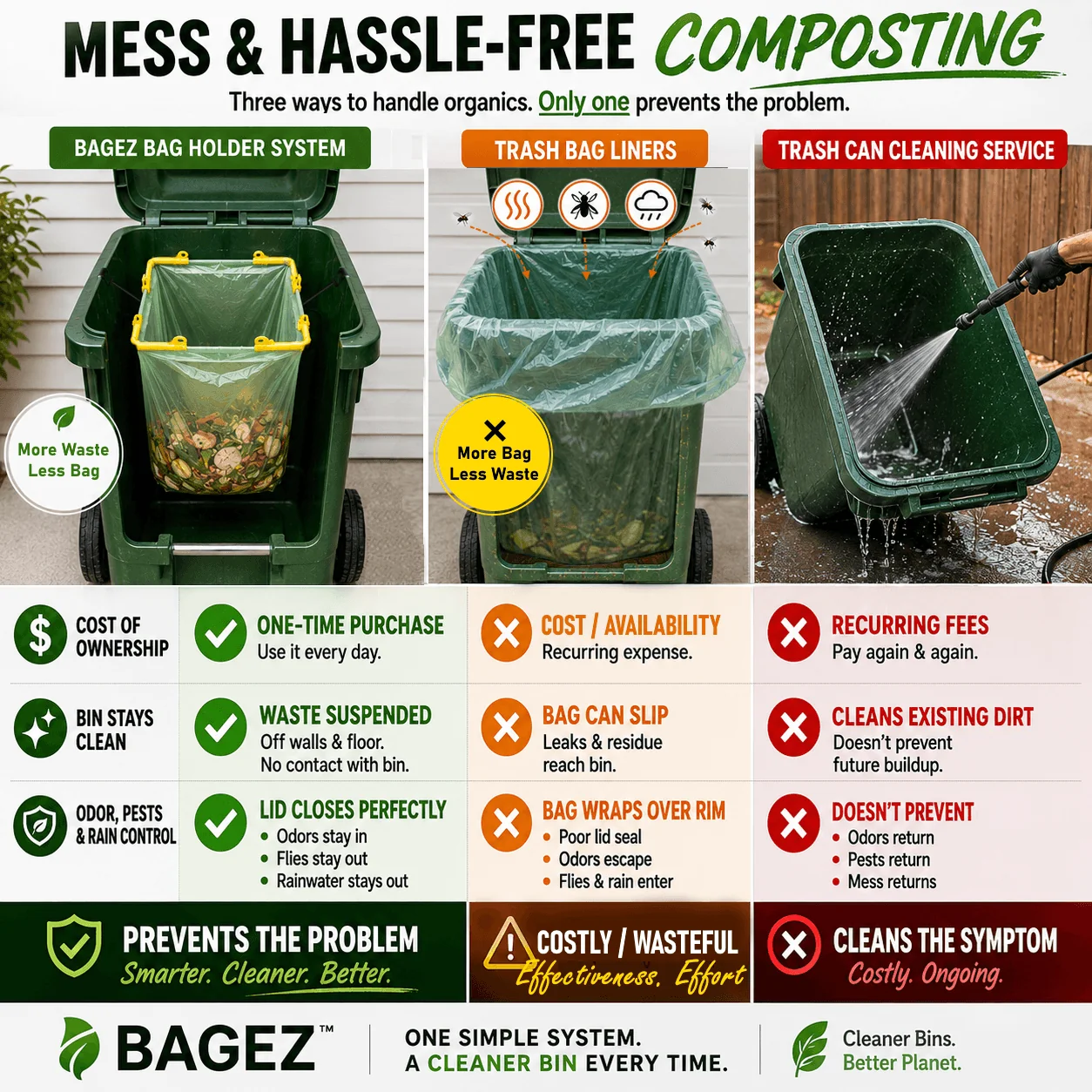
The Essex experiment highlights a critical insight: when municipalities provide tools that effectively contain waste, participation rates rise. However, the limitation of this model is scalability. Most municipal budgets cannot sustain a perpetual giveaway of liners or bins. This leaves a significant gap in the market for sustainable, long-term solutions that allow residents to maintain bin cleanliness without the recurring cost of single-use plastics or the labor-intensive requirement of frequent power-washing.

Technical Challenges and Structural Solutions
The "yuck factor" is not merely a matter of perception; it is a thermodynamic and biological reality. Produce, which makes up a significant portion of household food waste, is composed largely of water. As this material breaks down, it releases moisture. In a standard curbside bin, this liquid settles at the bottom, creating a nutrient-rich environment for anaerobic bacteria and pests.
The traditional solution—lining the entire bin—is often prohibitively expensive for the average household and frequently creates its own problems, as large liners are difficult to manage and prone to tearing. Recently, engineering approaches have shifted toward the use of suspended frames, such as the BagEZ system. By utilizing a collapsible steel frame that hangs from the rim of a standard 13-gallon (49-liter) or larger bin, these systems keep the waste bag suspended.
This creates an air gap between the bag and the walls of the bin. The impact of this simple design change is twofold:
- Evaporation: The constant airflow prevents condensation from accumulating at the base of the bin, effectively stopping the formation of the "sludge" that characterizes neglected organic waste containers.
- Odor Control: By maintaining a dry environment, the growth of odor-causing bacteria is significantly inhibited. Furthermore, the contained space allows for the more effective use of natural deterrents, such as baking soda or food-grade diatomaceous earth, which remain active only when kept dry.
The Impact of "Right-Sizing" Waste
A common misconception among homeowners is that the size of the bin dictates the amount of waste they should produce. Data from the MITRE-Gallup household food-waste study, which analyzed the habits of nearly 10,000 households, found that the average U.S. household produces only about 8.8 cups of food waste per week—including peels, bones, and scraps.

This volume is significantly less than the capacity of a standard 64-gallon or 96-gallon curbside cart. By focusing on a smaller, "right-sized" bag held within the bin, households can avoid the costs and environmental drawbacks of using massive, heavy-duty liners that are often unnecessary. This approach aligns with the "zero-waste" philosophy: using the minimum amount of material necessary to achieve the desired outcome.
Broader Implications for Municipal Policy
For municipal waste managers, the implications are clear: infrastructure is only as effective as the participation it generates. If a program is perceived as a "chore," it will fail. If it is perceived as a seamless, sanitary aspect of household life, it will succeed.
The transition to a more efficient model of waste collection requires a multi-pronged approach:
- Standardization: Municipalities must clarify their policies regarding liners. Some programs mandate certified compostable bags, while others strictly forbid them, fearing contamination. A lack of regional consistency creates friction and increases the likelihood of contamination at the processing facility.
- Education: As seen in the Essex County study, visual aids and clear instructions are essential for maintaining program momentum.
- Tooling: Encouraging or incentivizing the use of low-cost, durable containment tools—like the steel frames described—can reduce the burden on homeowners and, by extension, the volume of waste that ends up in landfills.
Analysis: A Path Forward
The path toward a circular economy for food waste is not found in more frequent collection schedules, which are costly and carbon-intensive, but in the efficiency of the household unit. As urban density increases, the management of organic waste will become a flashpoint for municipal budgets. Cities that prioritize user experience—by addressing the hygiene and convenience concerns of their citizens—are likely to see higher diversion rates and, consequently, lower landfill fees.

The reliance on outdated methods, such as throwing loose scraps into an unlined plastic bin, is a vestige of an era where waste was an "out of sight, out of mind" issue. Today, as landfills approach capacity and methane regulations tighten, the "green bin" has become a vital piece of critical infrastructure. Ensuring it remains functional requires a shift in how we handle the daily disposal of organic materials.
The success of programs like the one in Essex County and the adoption of simple, scalable technologies suggests that the "yuck factor" is not an insurmountable barrier. It is a design challenge. By focusing on containment, dryness, and the effective use of materials, municipalities and residents can turn a daily nuisance into a reliable, consistent, and environmentally impactful habit. The data suggests that once the logistical hurdle of the "dirty bin" is removed, the vast majority of households are more than willing to participate in the broader effort to divert organic waste from landfills. The future of municipal composting depends not just on the technology at the processing plant, but on the ease of the process in the backyard.