

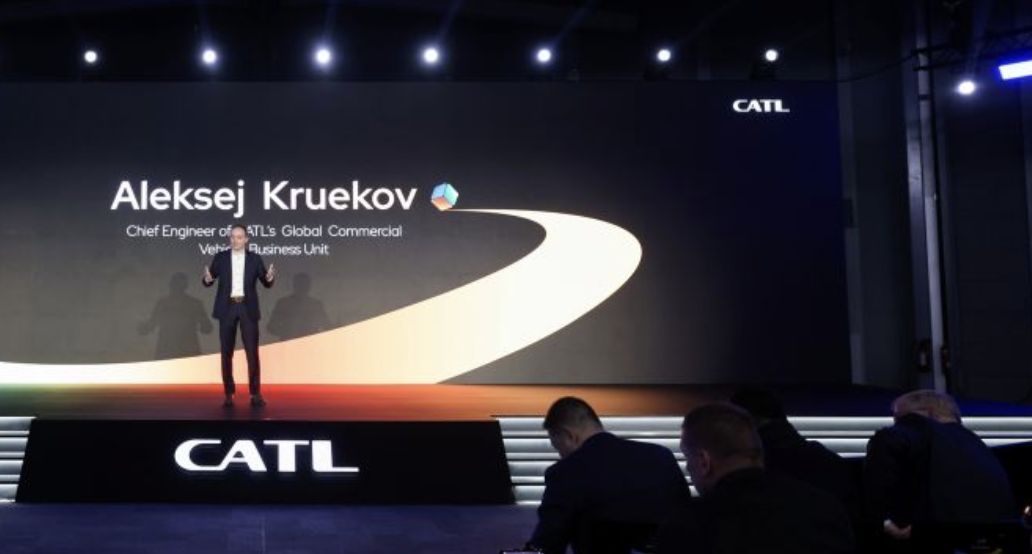
At the 2026 IAA Transportation conference in Hanover, Germany, Contemporary Amperex Technology Co. Ltd. (CATL) took a decisive step toward the total decarbonization of the global logistics sector by unveiling TECTRANS II. This modular battery architecture represents a fundamental shift in how heavy-duty transport is powered, offering a landmark 1,000-kilometer range and megawatt-level fast-charging capabilities. As the commercial vehicle industry faces mounting pressure to meet stringent emissions standards, CATL’s latest innovation aims to resolve the long-standing friction between vehicle uptime, payload capacity, and energy density.
The Evolution of Commercial Electrification
The introduction of TECTRANS II at the world’s leading trade fair for transportation and logistics serves as a strategic marker in the industry’s timeline. While passenger vehicle electrification has moved at a rapid pace over the last decade, the heavy-duty sector—responsible for a significant portion of global logistics emissions—has struggled with the limitations of current battery technology.
Heavy trucks have historically required immense battery packs that encroached on cargo capacity, or alternatively, limited their operational range to short-haul routes. CATL’s TECTRANS II addresses these constraints through a standardized, modular design philosophy. By utilizing a "lego-like" approach, the platform allows manufacturers to configure energy capacity and payload requirements with unprecedented flexibility. This modularity extends to the propulsion system, as the architecture is designed to support both e-axle and central-drive configurations, making it compatible with a wide array of chassis designs.
Technical Specifications and Performance Metrics
The core of the TECTRANS II platform is its high-performance battery chemistry, which boasts a gravimetric energy density of 170 watt-hours per kilogram (Wh/kg). This metric is critical for commercial operators; increased density allows for lighter battery packs, which directly translates to approximately 0.6 metric tons of additional payload capacity compared to previous generation systems. For fleet operators, this represents a tangible economic advantage, enabling more goods to be moved per trip without exceeding gross vehicle weight limits.
Durability and longevity, often cited as the "Achilles’ heel" of electric freight, have been central to the engineering of this platform. CATL has specified a service life of 12 years or 1.5 million kilometers. Even after this intensive operational lifespan, the batteries are expected to retain 70% of their initial capacity. This longevity is supported by a robust, safety-focused physical architecture. The enclosure features an aluminum frame reinforced with crush-resistant ribs and a hardened bottom plate, providing 15 years of corrosion protection. Furthermore, the system employs redundant, independent battery-management branches. In the event of a cell or module failure, the system can isolate the affected section, ensuring that the truck remains operational and avoiding costly emergency roadside recovery.
The Megawatt Charging Revolution
For the logistics industry, time is equivalent to operational revenue. The "downtime dilemma"—where vehicles must remain stationary for long periods to charge—has been a major barrier to the adoption of electric heavy-duty vehicles. TECTRANS II mitigates this through support for megawatt-level charging, allowing the battery to reach an 80% state of charge in just 25 minutes.
This charging speed is designed to align with mandatory driver rest periods, effectively neutralizing the downtime disadvantage. By integrating this technology into long-haul operations, fleets can now realistically plan for high-utilization routes that were previously considered impossible for electric trucks. The 1,000-kilometer (approximately 621-mile) range per charge further facilitates cross-border and regional logistics, positioning battery-electric vehicles as a viable, direct competitor to diesel-powered alternatives.
Strategic Partnerships and Infrastructure Development
The announcement at IAA Transportation was accompanied by a significant expansion of CATL’s collaborative efforts, most notably through a memorandum of understanding with the DHL Group. This agreement aims to develop "green freight corridors" across Europe. While previous iterations of this partnership focused primarily on the hardware of battery technology, the 2026 agreement marks a pivot toward the broader ecosystem.
DHL and CATL intend to work in tandem with original equipment manufacturers (OEMs) and energy infrastructure providers to build the necessary network for large-scale electric freight deployment. By combining DHL’s extensive logistics network with CATL’s battery expertise, the collaboration seeks to solve the "chicken and egg" problem of electric trucking: the lack of infrastructure hindering vehicle adoption, and the lack of vehicles hindering infrastructure investment. This strategic shift highlights a growing consensus that successful fleet electrification requires a holistic approach, encompassing software, charging hardware, and route optimization.

Economic and Operational Implications
The financial impact of the TECTRANS II platform is expected to be significant for the global manufacturing sector. CATL estimates that the standardized design architecture could reduce commercial vehicle development cycles by approximately 50%. By removing the need for bespoke battery engineering for every vehicle model, manufacturers can achieve a 60% to 70% reduction in research and development costs.
This reduction in overhead is likely to accelerate the market entry of diverse electric models, including medium-duty trucks, buses, and specialized delivery vehicles. As development cycles shorten, the rate of technological iteration will increase, potentially lowering the total cost of ownership (TCO) for fleet operators. When factoring in the lower maintenance costs of electric powertrains and the reduced energy costs compared to diesel, the TCO parity between electric and internal combustion engine (ICE) heavy-duty vehicles is rapidly approaching.
Future Outlook and Market Impact
The launch of TECTRANS II arrives at a critical juncture in the global energy transition. With passenger vehicle electrification nearing a state of maturity in many developed markets, the industry’s focus has naturally shifted to the "next frontier"—commercial transport.
The technical achievements showcased by CATL—specifically the 1,000-kilometer range and the 96% round-trip efficiency provided by its full-tab, low-impedance design—set a new industry benchmark. However, the success of this platform will ultimately depend on the widespread rollout of megawatt-level charging infrastructure across major transit arteries. While the battery technology is now ready for deployment, the infrastructure gap remains a logistical hurdle that will require continued public-private cooperation, similar to the model currently being piloted by DHL and CATL.
As we look toward the latter half of the 2020s, the integration of high-density battery platforms like TECTRANS II into mainstream logistics signals that the era of the electric long-haul truck is no longer a theoretical possibility, but a commercial reality. For regulators, fleet owners, and the broader supply chain, the focus now turns to scaling these solutions. The transition to electric commercial transport is no longer just about the environment; it is increasingly defined by the competitive necessity of efficiency, durability, and the ability to leverage standardized, high-performance energy storage to drive global trade.








Leave a Reply