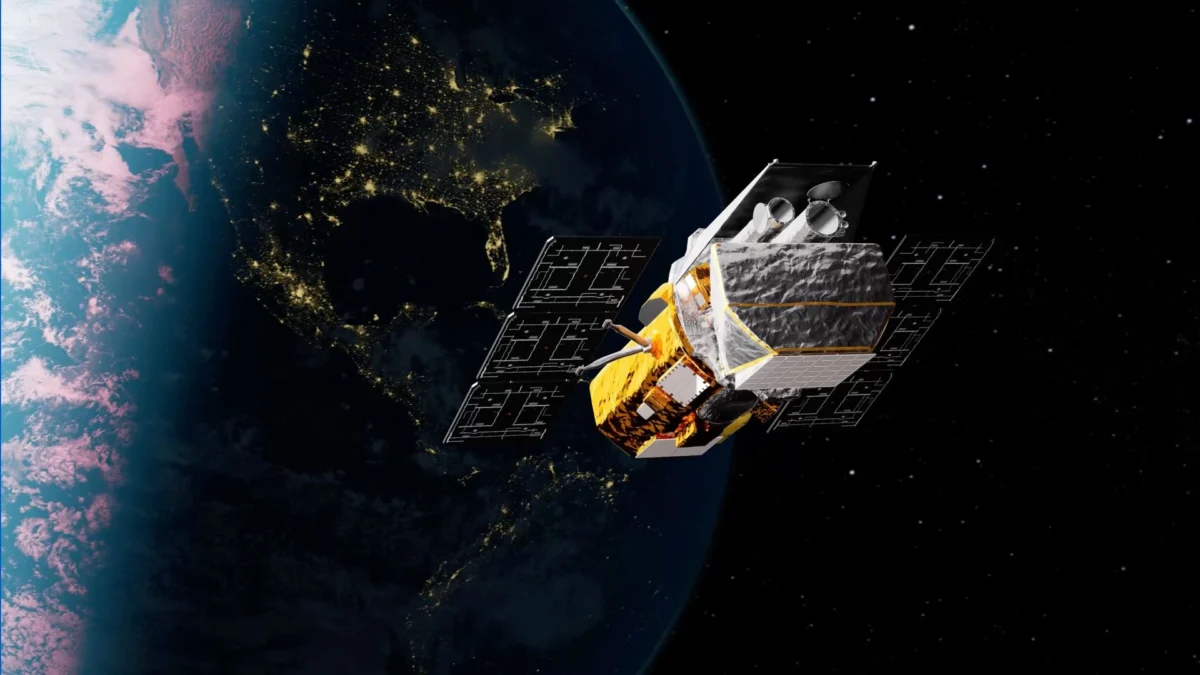
NASA’s Neil Gehrels Swift Observatory has officially met its fiery end, burning up in Earth’s atmosphere after nearly 22 years of groundbreaking service. The spacecraft, which revolutionized how astrophysicists study the most violent and energetic events in the universe, re-entered Earth’s atmosphere over Indonesia. According to official orbital tracking data released by the space agency, the final descent occurred at 7:39 a.m. EST on a Wednesday over the North Sumatra region, specifically pinpointed at approximately 3.4 degrees north latitude and 98.6 degrees east longitude.
Mission controllers and orbital debris specialists had closely monitored the decaying orbit of the spacecraft in the weeks leading up to its re-entry. NASA estimated that the vast majority of the observatory’s hardware would disintegrate due to intense frictional heating as it plowed through the upper atmosphere at hypersonic speeds. Statistical modeling indicated that the probability of any surviving metallic or composite debris reaching the ground in a populated area was roughly 1 in 2,100. Local authorities and international monitoring networks confirmed that no structural damage, property loss, or injuries were reported as the remnants safely descended toward remote terrain or the open ocean.
The conclusion of the Swift mission marks the end of one of the most remarkably productive and enduring chapters in modern space-based astronomy. Originally designed as a rapid-response observatory, Swift vastly outperformed its expected operational lifespan, transforming humanity’s understanding of gamma-ray bursts, black holes, and transient cosmic phenomena.
Main Facts and the Final Descent
The atmospheric plunge of the Swift observatory brings a definitive conclusion to a satellite that became a cornerstone of multi-messenger astrophysics. Launched in November 2004, the spacecraft was engineered to solve a specific and enduring astrophysical mystery: the origin and nature of gamma-ray bursts (GRBs), which are the most luminous electromagnetic events known to occur in the universe since the Big Bang.
During its nearly 22 years in low-Earth orbit, Swift operated as an automated sentinel. It was uniquely capable of slewing—or rotating—its sensitive instruments toward a newly detected explosion in a matter of seconds. This rapid-response capability allowed astronomers to capture the fleeting afterglows of gamma-ray bursts across X-ray, ultraviolet, and optical wavelengths before they faded into obscurity.
As the satellite’s orbital altitude degraded over decades due to lingering atmospheric drag and solar cycle fluctuations, mission operators prepared for the inevitable conclusion. The final re-entry trajectory over North Sumatra unfolded precisely as projected by orbital mechanics models. Because the spacecraft was not equipped with a controlled propulsion system capable of executing a targeted de-orbit burn into a remote oceanic spacecraft graveyard, its descent was governed entirely by natural atmospheric friction. NASA’s rigorous pre-entry assessments proved accurate, as thermal shielding failure and extreme aerodynamic pressures successfully vaporized the bulk of the observatory before impact.
Chronology of a Legendary Mission
The history of the Swift observatory is defined by decades of innovation, resilience, and extraordinary scientific output. A chronological examination of the mission highlights its evolution from an ambitious proposal to an indispensable pillar of space science:
- November 20, 2004: The Swift observatory successfully launches aboard a Delta II rocket from Cape Canaveral Air Force Station in Florida, embarking on a planned two-year baseline mission.
- December 2004: Swift captures its first gamma-ray burst, demonstrating the seamless coordination of its onboard Burst Alert Telescope (BAT), X-Ray Telescope (XRT), and Ultraviolet/Optical Telescope (UVOT).
- 2007: Having successfully completed its primary two-year mission objectives, NASA approves the first of many extended missions, recognizing the spacecraft’s unmatched value to the global astronomical community.
- 2010–2015: The telescope expands its scientific portfolio well beyond gamma-ray bursts. It begins conducting extensive surveys of comets, supernovae, tidal disruption events (where a star is shredded by a supermassive black hole), and active galactic nuclei.
- 2018: In recognition of the visionary leadership of its principal investigator, who passed away in 2017, NASA officially renames the spacecraft the Neil Gehrels Swift Observatory.
- 2020–2024: Despite advancing age, component wear, and occasional safe-mode anomalies, the observatory continues to deliver critical data, frequently assisting ground-based observatories and gravitational-wave detectors by pinpointing transient electromagnetic counterparts.
- Late 2025 – Early 2026: Increased solar activity accelerates the expansion of Earth’s upper atmosphere, increasing drag on the satellite and causing its orbital decay to enter a terminal phase.
- November 2026: Swift officially reaches the end of its operational lifecycle, re-entering Earth’s atmosphere over Indonesia and disintegrating safely.
Supporting Data and Scientific Contributions
The legacy of the Swift observatory is enshrined in petabytes of archival data and thousands of peer-reviewed scientific papers. Over its 22-year tenure, the telescope fundamentally reshaped high-energy astrophysics.
Before Swift, gamma-ray bursts were enigmatic flashes of high-energy photons that appeared randomly across the sky, lasting anywhere from a fraction of a second to several minutes. Because they vanished so quickly, pinning down their host galaxies and understanding the physics driving them proved nearly impossible. Swift changed this paradigm by reducing the detection-to-slewing window to under a minute.
Key data metrics underscore the mission’s monumental impact:
- Over 1,500 Gamma-Ray Bursts: Swift detected and localized more than 1,500 distinct gamma-ray bursts, providing the statistical sample size required for modern theoretical models.
- Cosmic Distance Records: The observatory helped measure the redshift of some of the most distant objects in the universe, capturing explosions that occurred when the universe was less than a billion years old.
- Tidal Disruption Events: Swift cataloged dozens of instances where wandering stars strayed too close to dormant supermassive black holes, offering unprecedented real-time data on accretion physics.
- Cometary Chemistry: The Ultraviolet/Optical Telescope instrument made groundbreaking observations of the water production rates and volatile gas emissions of numerous comets passing through the inner solar system.
These contributions established Swift not merely as a single-purpose satellite, but as a flexible, multi-wavelength laboratory capable of responding to the dynamic, ever-changing cosmos.
Official Responses and Professional Reactions
The scientific community has expressed profound gratitude for the mission, alongside a sense of loss as the spacecraft transitions from orbit to history. Astrometric institutions, university research departments, and space agencies worldwide have shared tributes honoring the engineering teams and scientists who kept the mission running far beyond its initial design life.
"Swift was a trailblazer that redefined how we practice time-domain astronomy," noted a senior astrophysicist familiar with high-energy missions. "It bridged the gap between theoretical physics and real-time observation. The architecture of the spacecraft allowed us to catch the universe in the act of transformation. While we mourn the loss of the hardware, the baseline of data it leaves behind will fuel research for generations of graduate students and seasoned researchers alike."
NASA program managers emphasized that the operational success of Swift paved the way for modern automated astronomy networks. The lessons learned in rapid-slew spacecraft design, automated alert distribution, and multi-wavelength instrument integration have been directly incorporated into newer space missions and ground-based facilities, such as the Vera C. Rubin Observatory.
Engineering teams who managed the spacecraft through its twilight years also reflected on the resilience of the hardware. Operating in the harsh radiation environment of low-Earth orbit for over two decades required continuous software patches, workaround solutions for failing reaction wheels, and meticulous thermal management. The fact that the spacecraft remained scientifically viable deep into the 2020s is a testament to the rigorous standards of its initial construction and the ingenuity of its ground operators.
Broader Impact and Implications for Future Astronomy
The retirement of the Swift observatory leaves a temporary capability gap in space-based hard X-ray and gamma-ray monitoring, prompting international space agencies to accelerate plans for successor missions. While observatories like NASA’s Fermi Gamma-ray Space Telescope remain operational, Swift’s unique combination of rapid automated slewing and simultaneous ultraviolet, optical, and X-ray observations made it irreplaceable for pinpointing precise coordinates of transient sources.
As the astronomical community moves into an era dominated by multi-messenger astronomy—where scientists combine light, gravitational waves, and neutrinos to study the cosmos—the methodologies pioneered by Swift are more relevant than ever. Modern facilities rely on the exact framework established by the Swift team: instant global alerts, rapid coordination between space and ground assets, and open-access data pipelines that allow researchers worldwide to pivot their telescopes within minutes of a cosmic explosion.
The atmospheric burn-up of the Neil Gehrels Swift Observatory closes an extraordinary chapter in space exploration. Though the physical satellite is gone, its scientific footprint remains indelible. By illuminating the darkest corners of the universe with flashes of high-energy light, Swift expanded human knowledge, challenged established astrophysical models, and proved that even the briefest moments in the cosmos can leave a permanent mark on science.