
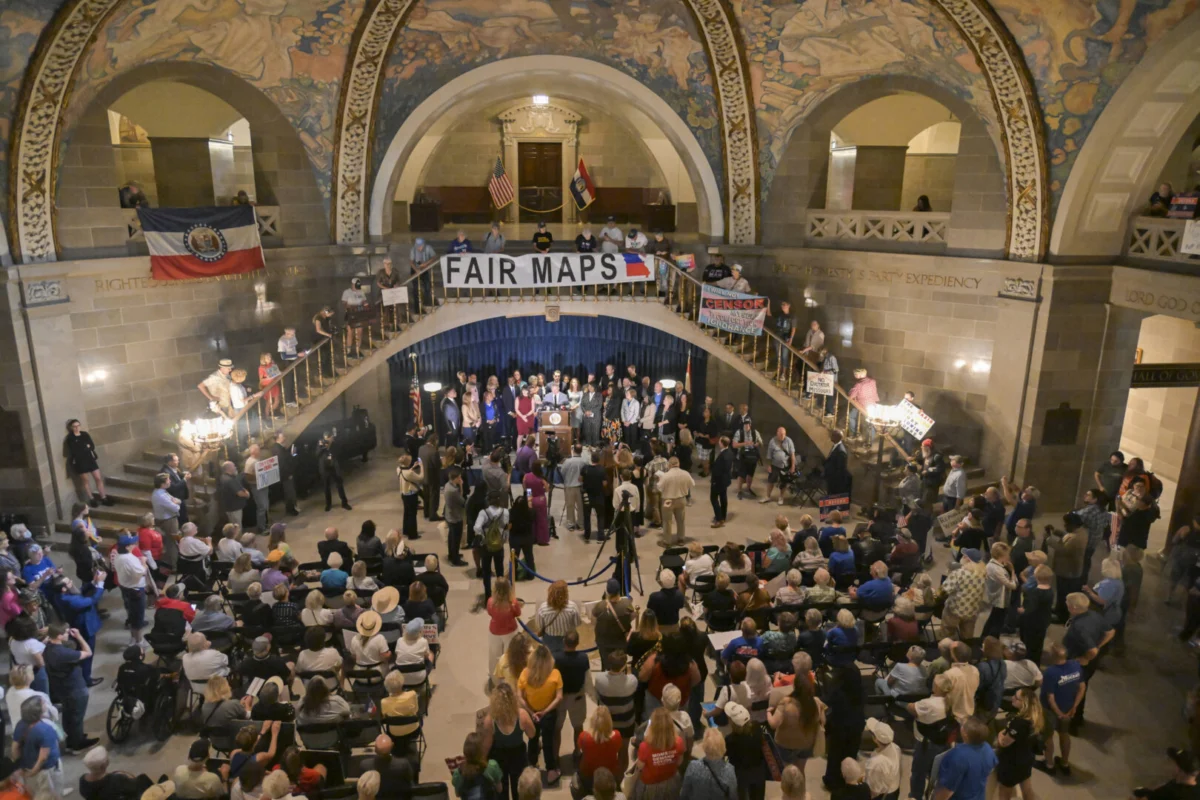
The legal landscape surrounding Missouri’s congressional districts descended into further uncertainty this week, as a federal appeals court issued a directive that could force a last-minute overhaul of the state’s electoral geography. On Monday, a three-judge panel of the U.S. Court of Appeals for the 8th Circuit ruled in favor of reinstating a Republican-backed congressional map, effectively overturning a lower court’s reliance on a previous iteration of the state’s district lines. This latest development sets the stage for a high-stakes appeal to the U.S. Supreme Court, marking the third time in recent months that the highest court in the land may be asked to intervene in the "Show-me State’s" turbulent redistricting process.
The 8th Circuit’s decision centers on the premise that the state’s utilization of a 2025 legislative map for the August primaries necessitates its continued use for the November general election. In their opinion, the judges noted that the current reliance on the 2022 map—which had been the fallback option—is constitutionally insufficient. "This Court holds that Missouri’s current plan to use the 2022 map in the November 2026 general election violates the Constitution," the panel wrote. "Only use of the 2025 map complies with the Constitution and federal law."
A Timeline of Legal Whiplash
To understand the current impasse, one must trace the rapid series of shifts that have defined Missouri’s redistricting saga over the past two years. The state’s electoral boundaries have been a primary battleground for partisan control, with the 2025 map designed specifically to bolster Republican margins, notably placing the Kansas City-based district held by Democratic Representative Emanuel Cleaver II in a more precarious position.
- 2025 Legislative Session: The Missouri General Assembly approves a new congressional map, the 2025 plan, amid an aggressive nationwide push by GOP legislatures to secure partisan advantages in the House of Representatives.
- August 2026 Primaries: The state successfully conducts its primary elections using the 2025 map.
- September 2026 (Early): Following a state Supreme Court ruling that suggested the 2025 map could not be used due to pending ballot initiatives, the 2022 map is reinstated as the legal baseline.
- September 10, 2026: The U.S. Supreme Court grants an emergency appeal filed by the group "People Not Politicians Missouri," which temporarily halts the use of the 2025 map and restores the 2022 lines.
- September 21, 2026: The 8th Circuit Court of Appeals issues its reversal, demanding the state revert to the 2025 map, once again throwing the logistics of the November election into disarray.
The Logistics of a Mid-Cycle Map Change
The central tension of this case lies in the collision between constitutional mandates and the practical realities of election administration. By the time the 8th Circuit issued its Monday ruling, the gears of the November election were already turning. Absentee ballots have been printed, and in some jurisdictions, voters have already cast their ballots.
Richard von Glahn, executive director of People Not Politicians Missouri, emphasized the administrative chaos this ruling creates. "Ballots have been printed, and Missourians have already voted. Thousands more will vote before this order seeks to take effect," von Glahn stated. "Officials should stop wasting taxpayers’ money on pointless legal action and instead focus on administering our elections."
Election experts note that shifting district lines once the voting process has commenced is an unprecedented administrative burden. It requires election officials to void existing ballots, re-issue new ones, and manage the inevitable voter confusion that follows such a late-stage change. This scenario raises significant questions regarding the "Purcell Principle," a long-standing federal judicial doctrine that cautions against federal courts changing election rules close to the date of an election to avoid voter confusion and administrative disruption.
Partisan Implications and Strategic Intent
The 2025 map is not merely a technical adjustment; it is a strategic maneuver designed to alter the political composition of the Missouri delegation. By consolidating Republican voters and thinning the Democratic base in urban centers like Kansas City, the 2025 plan effectively targets the Democratic minority in the state.
For the Republican proponents of the 2025 map, such as Representative Bob Onder, the legal argument is rooted in legislative prerogative. They contend that the map adopted by the state legislature represents the will of the state’s elected representatives and should therefore be the governing document for all federal contests within the state. Conversely, opponents argue that the map was drafted in bad faith to dilute the influence of urban voters and that the pending ballot initiatives—which sought to introduce independent redistricting commissions—should have precluded the implementation of such a partisan map.
The Role of the U.S. Supreme Court
With the 8th Circuit’s ruling now in the public record, the case is widely expected to return to the U.S. Supreme Court. The legal question is no longer just about the map itself, but about the federal judiciary’s role in overriding state-level election procedures during the final weeks of an active election cycle.
Should the Supreme Court choose to hear the case, it will face a narrow window of time to reach a decision. If the court upholds the 8th Circuit’s ruling, Missouri will be forced to finalize a map that deviates from the one used for absentee ballots, likely triggering an immediate and intense scramble at the local level to ensure that every vote cast is counted in the correct district. If the court sides with the plaintiffs, it would effectively cement the 2022 map for the duration of the 2026 cycle, providing a finality that election administrators are currently desperate for.
Broader Implications for Redistricting
The Missouri case serves as a high-profile microcosm of the national struggle over redistricting. Across the United States, the line between "partisan gerrymandering" and "legislative authority" has become increasingly blurred. As state legislatures exert more control over the drawing of district lines, the courts are frequently called upon to act as referees. However, when the courts themselves become divided—as evidenced by the conflicting rulings between the Missouri Supreme Court, federal district courts, and the 8th Circuit—the resulting instability can erode public confidence in the electoral process.
The legal battle in Missouri also highlights the growing influence of ballot initiatives as a check on legislative power. When state legislatures act to secure partisan gains through redistricting, citizens are increasingly turning to the initiative process to demand independent oversight. The fact that the current legal fight stems from a collision between a legislative act and an ongoing ballot campaign underscores the volatility of state-level politics.
As Missouri moves toward the November general election, the eyes of the nation will be fixed on the Supreme Court. The decision they reach will not only determine the congressional representatives for Missouri for the next two years but will also provide a definitive precedent on how much flexibility states have to alter their electoral maps once the voting process has already begun. For now, the "Show-me State" remains in a state of suspended animation, waiting for the judiciary to provide the clarity required to finalize its democracy.








Leave a Reply